The Lyrical Pulse: Defining Characteristics of East Galway Music in 2026
- Paraic Mac Donnchadha

- Jul 4
- 13 min read
What if the most powerful pulse in Irish music isn't found in the fastest reels, but in the deliberate silence between the notes? Many listeners today feel exhausted by the mechanical, high-speed pace of modern sessions that can feel more like a race than a living tradition. If you have ever struggled to hear the difference between regional styles, understanding the defining characteristics of east galway music is the key to unlocking a deeper, more emotional connection to the tunes. It's a style that prioritizes soul over speed; a melodic philosophy where every ornament and pause tells a story.
I know that feeling of being overwhelmed by academic musicology, but the "lonesome" quality of this region is something you feel in your bones rather than read in a textbook. In this guide, we will peel back the layers of this contemplative tradition, from the unhurried rhythmic strength of the Old Kill style to the haunting G and D minor keys favored by Paddy Fahey. You will learn how to identify that plaintive "East Galway" lift in recordings and see how the tenor banjo has evolved from a background rhythm into a lyrical lead voice. Let's move beyond the noise and start building a collection of music that truly breathes.
Table of Contents
The Soul of the West: What Defines the East Galway Style?
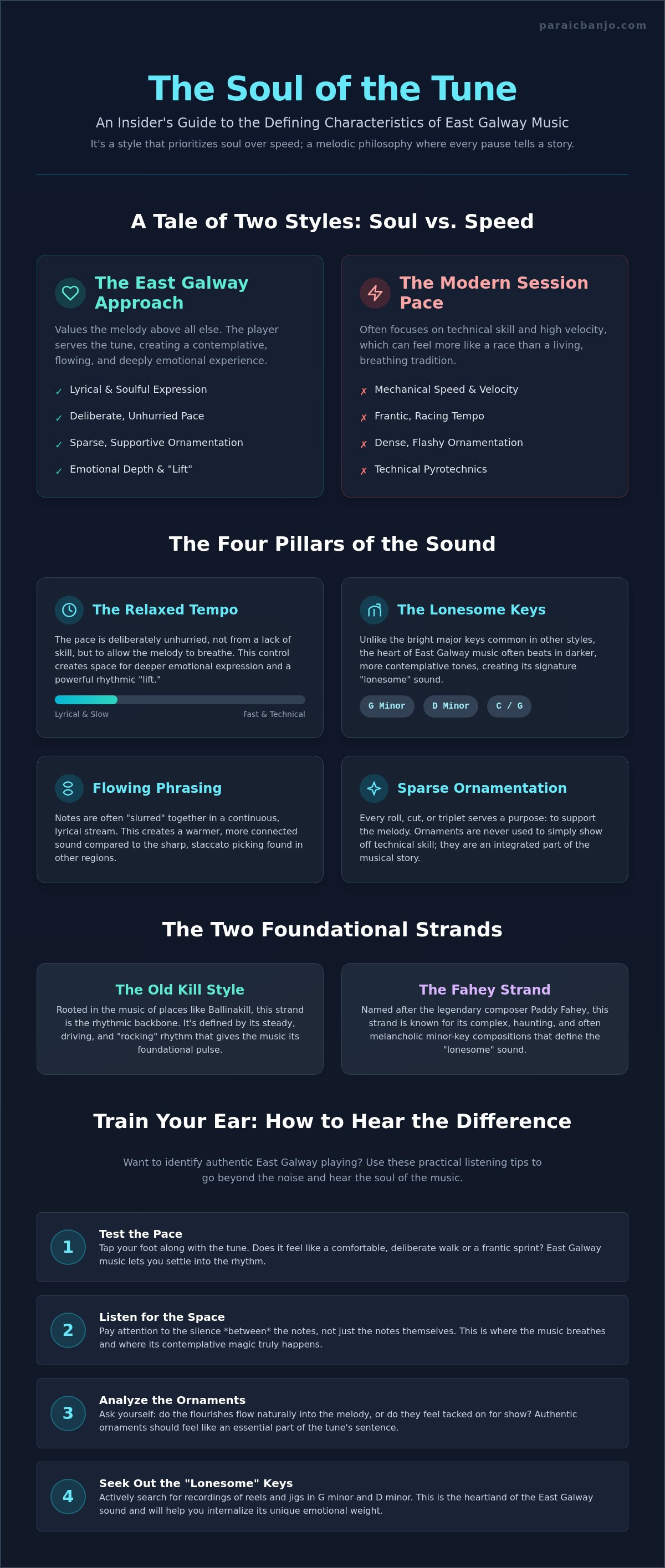
Step into any session where the East Galway style is king, and you'll immediately notice something different. It isn't a race. While other regions might lean into technical pyrotechnics, this tradition is all about the lyrical pulse. When we look at the defining characteristics of east galway music, the first thing that hits you is the restraint. It's a contemplative, flowing approach that values the melody above everything else. There's no room for ego here; the player serves the tune, not the other way around. Understanding these nuances helps you appreciate why certain tunes feel so much more grounded and soulful than a standard session reel.
This stands in sharp contrast to the famous Sligo style, which is often celebrated for its incredible speed and dense, flashy ornamentation. In East Galway, we let the notes breathe. This unhurried pace isn't about a lack of skill. Quite the opposite. It takes immense control to play slowly and still maintain a driving, rhythmic lift. You can hear this foundational philosophy throughout the history of Irish traditional music, where regional identities were once as distinct as local dialects. If you want to train your ear, try listening to a tune and focusing on the space between the notes rather than the notes themselves. That's where the magic happens.
The Regional Heartbeat: Galway, Clare, and Tipperary
The music doesn't stop at the county line. This style is a living thing that flows freely between East Galway, East Clare, and North Tipperary. For decades, geographic isolation in places like Ballinakill helped preserve these specific rhythmic patterns. Before the internet made every style available at a click, the local crossroads dance was the heartbeat of the community. This isolation meant that the music developed a unique regional identity that focused on a steady, rocking rhythm rather than the frantic pace of the city. If you want to hear this authentic connection, try listening to the tracks on Not Before Time – 39 Years in the Making, where these regional influences are woven into every set.
Defining the 'Lonesome' Sound
You'll often hear old-timers talk about the "lonesome" quality of the music. In Irish, we call this draíocht, a word that translates to magic or soul, but it's really about a haunting emotional depth. It's that feeling in a minor-key reel that makes the hair on the back of your neck stand up. This isn't just "sad" music; it's music with weight. One of the most vital defining characteristics of east galway music is this specific, plaintive feeling that resonates with listeners looking for something raw and authentic. It's a sound I've spent nearly four decades trying to capture. If you're looking to bring this into your own listening habits, start by seeking out tunes in G minor or D minor; these are the keys where the lonesome soul of Galway really sings.
Lyrical vs. Technical: The Core Characteristics of the Sound
If you've ever sat in a session and felt like the reels were flying past at a speed that left the melody behind, the East Galway style will feel like coming home. One of the primary defining characteristics of east galway music is the deliberate, relaxed tempo that allows the tune to actually breathe. It's a conscious choice to slow things down. This isn't because the players lack the ability to play fast; it's because they believe the beauty of the music is hidden in the phrasing rather than the velocity. When you take the rush out of the music, you find room for a much deeper emotional expression.
In this tradition, we generally follow a "sparse ornamentation" rule. Every roll, cut, or triplet is there to support the melody, never to show off the player's technical skill. You'll notice a distinct "slurred" phrasing where multiple notes flow into one another. Instead of the sharp, staccato picking found in other regions, this style feels like a continuous, lyrical stream. It creates a warmer, more connected sound that fits perfectly with our preference for lower keys like C, G, and various Dorian modes. While a huge portion of Irish music leans toward bright major keys, the heart of Galway often beats in the darker, more contemplative tones of G and D minor.
The Power of the Lower Register
Many discussions on Irish music focus almost exclusively on the fiddle or flute, but the tenor banjo plays a massive role in shaping this regional sound. In East Galway, we tend to avoid those high-pitched, screechy notes that can dominate a room. Instead, we live on the G and D strings. These lower strings offer a rich, honeyed tone that blends seamlessly with the woody resonance of a timber flute. If you're listening to recordings, pay close attention to that specific resonance. It's a thick, grounded sound that provides a foundation for the entire set. You can hear this tonal balance in action throughout the individual digital tracks of my latest collection, where the banjo's lower register is given the space it truly deserves.
Rhythmic Strength Without the Rush
There's a big difference between playing fast and playing with drive. A tune can be slow in terms of beats per minute but still possess an incredible rhythmic pulse. I like to think of the rhythmic pulse as the internal heartbeat of a reel that guides the dancer's feet. It’s a steady, rocking motion that never feels frantic. Even when the tempo is unhurried, the rhythm remains rock-solid and completely danceable. To get a feel for this yourself, try tapping your foot to the "backbeat" of the tune rather than trying to follow the melody notes. You'll find a deep, driving energy that doesn't need speed to be powerful.
The Four Pillars: Understanding the Different Strands of the Style
While we've explored the general mood of the region, it's helpful to see the East Galway tradition as a collection of four main pillars. These aren't separate silos. They are more like different threads woven into the same vibrant fabric. Understanding these specific strands is essential to grasping the defining characteristics of east galway music because they explain why the style feels so layered and complex. From the early days of 78rpm recordings to the modern session, these influences have merged to create something truly unique.
We also have to acknowledge the massive impact of the accordion and the flute. Legends like Joe Cooley and Paddy O'Brien brought a specific phrasing to the music that emphasized a steady, rocking "lift." This phrasing naturally bled into how other instruments are played. Today, the flute and banjo have become the backbone of the modern Galway sound. The percussive clarity of the banjo strings provides a perfect contrast to the breathy, woody resonance of the timber flute. When played together, they create a texture that is both driving and deeply lyrical.
The Legacy of the Ballinakill Céilí Band
The story really begins in the 1920s with the Ballinakill Céilí Band. Their early recordings changed the game for everyone. They pioneered a synchronized ensemble sound where every player moved together with a unified, rock-solid rhythm. This wasn't about flashy individual solos. It was about a collective pulse that felt unhurried yet incredibly strong. Their rhythmic stability became the blueprint for the regional style we love today. If you want to hear this communal energy for yourself, you can explore traditional Irish session music CDs that capture that same authentic spirit of collaboration.
Paddy Fahey and the 'Lonesome' Modal Shift
Then we have the Fahey strand. Paddy Fahey was a master composer whose tunes are now considered the gold standard for any Galway musician. He had a genius for finding beauty in "flat" keys like G minor, C minor, or D minor. These tunes often take unexpected melodic turns that feel haunting and soulful. These compositions demand a more thoughtful, rhythmic banjo approach. You can't just blast through a Fahey reel. You have to lean into those modal shifts to find the "lonesome" heart of the tune. It's about finding the magic in the minor key. These tunes are one of the most vital defining characteristics of east galway music, proving that you don't need major keys to create a sense of joy and lift.
Developing Your Ear: How to Identify Authentic East Galway Playing
You don't need a degree in musicology to spot the real deal. Identifying the defining characteristics of east galway music is more about training your heart to recognize a specific feeling than it is about counting notes. It's a skill that comes with time, but you can fast-track the process by knowing exactly where to point your ears. When you move past the initial wall of sound in a session, you'll start to hear the intricate choices that make this region’s music so soulful. It’s about listening for the intent behind the notes.
The Foot-Tap Test: Try tapping your foot along to the beat. If the tempo feels so frantic that your foot can't keep a steady, comfortable rhythm, it likely isn't the East Galway style. We play at a pace that invites the listener in rather than leaving them behind.
Listen for the Flowing Roll: A roll is a quick cluster of notes used to decorate a melody. In Galway, these shouldn't sound like sharp, mechanical bursts. Instead, listen for ornaments that flow smoothly into the next phrase, almost like a singer’s breath.
Spot the Shadowy Keys: Many of our most famous tunes are built on modal roots. These are scales that aren't strictly "happy" major keys, which gives the music a shadowy, ancient quality. If a tune feels like it’s hovering between light and dark, you’ve likely found a Galway classic.
Find the Banjo's Pop: The banjo shouldn't just be a loud, percussive machine. In an authentic Galway setting, the banjo provides a steady, soulful drive with a clean "pop" that emphasizes the melody's internal heartbeat.
The Role of the Banjo in Regional Style
For too long, the banjo was treated like a rhythmic hammer, but in our neck of the woods, it’s a storytelling instrument. I’ve always believed in moving away from those "machine-gun" triplets that can clutter a tune. Instead, I focus on melodic clarity. This approach allows the banjo to act as a bridge between East Galway and Clare music, blending the lyrical flow of one with the rhythmic lift of the other. It’s about making the instrument sing the story of the West. If you want to hear this storytelling in action, you can browse my collection of individual digital tracks to find the tunes that speak to you.
Collector's Checklist for Authenticity
When you're building your library, don't just go for the most polished, over-produced studio albums. Authentic Galway music usually has a "live" or "session" feel, where you can almost hear the floorboards creaking. Check the liner notes for mentions of the Ballinakill tradition or the compositions of Paddy Fahey. These names are the markers of the soil. I always recommend seeking out independent releases where the artist has a direct, personal connection to the community. That’s where the true pulse of the tradition is preserved, far away from the commercial polish of mainstream labels. It’s the difference between a postcard and a home.
Preserving the Pulse: Why 'Not Before Time' is a Living Piece of History
Preserving a tradition isn't just about playing the old tunes; it's about capturing the exact feeling that makes them special. After thirty-nine years of playing across East Galway and Clare, I realized that many of the subtle, defining characteristics of east galway music were becoming harder to find in modern, high-speed recordings. This project, Not Before Time – 39 Years in the Making, was born from a need to document that unhurried, rhythmic soul before it fades into the background of a faster world. By bringing together a group of expert musicians who share this deep-rooted connection, we've managed to recreate the warm, conversational atmosphere of a true Irish session.
Each of the eighteen tracks is a testament to the belief that music should be felt, not just heard. This isn't a solo ego trip. It’s a collaboration that values the collective pulse over individual flashiness. Whether you prefer the tactile feel of a physical CD or the convenience of a digital album, these recordings offer a direct link to a style that has defined my life's work. Supporting independent Irish music ensures that these regional nuances continue to thrive for the next generation of listeners. It’s about keeping the story alive.
Inside the 18 Tracks of 'Not Before Time'
Within this collection, you'll find a curated selection of reels, jigs, and hornpipes that showcase the very best of the regional sound. From the shadowy modal shifts of a Fahey reel to the steady, driving lift of an old Ballinakill set, every note was chosen with care. For those who want to dive even deeper, the liner notes provide a wealth of background information on the tunes and the masters who passed them down. You can read the definitive story behind the Not Before Time album to see how nearly four decades of experience finally came together in the studio.
How to Support the Tradition Directly
Supporting the tradition directly is about more than just a purchase. It’s an investment in the defining characteristics of east galway music that make it so distinct from other regional styles. When you buy direct from the artist, you ensure that the resources go straight back into the craft. It allows us to keep producing high-quality, authentic material that ignores commercial trends in favor of traditional truth. If you're ready to start your own collection, you can browse the traditional Irish music for sale on my official site. Whether you choose the full digital album or select a few individual digital tracks, you're helping to keep this lonesome soul alive. In a world that often moves too fast, finding rhythmic mastery and soulful playing is, quite literally, not before time. Keep the pulse going!
Carry the Lonesome Soul With You
Finding the heart of a tune means looking past the speed and leaning into the soulful, unhurried rhythm that defines the West. We've explored how the defining characteristics of east galway music rely on melodic clarity and that haunting, lonesome quality found in the minor keys of Paddy Fahey. It’s a tradition that celebrates the collective pulse of the session rather than individual flashiness. Now that you know how to identify that authentic lift, it's time to bring that sound into your daily listening.
My debut project, Not Before Time, is the result of 39 years spent honing this specific craft. With 18 tracks recorded live alongside expert session musicians and featuring detailed historical liner notes, it’s a definitive statement of my life’s passion. Whether you’re a lifelong fan or a newcomer to the tradition, you can order the 'Not Before Time' physical CD or digital album today to experience this living history for yourself. Let’s keep this beautiful, rhythmic pulse beating for years to come. I'll see you down the road!
Common Questions About the East Galway Style
What is the difference between the East Galway and Sligo styles?
The main difference lies in the tempo and the density of the ornamentation. While the Sligo style is famous for its incredible speed and intricate, flashy decorations, the East Galway tradition focuses on a more relaxed, lyrical flow. We prioritize the melody's internal beauty, using ornaments sparingly to support the tune rather than show off technical speed. It’s a deliberate choice to let the music breathe and resonate.
Is the East Galway style always played slowly?
Not at all; the music is better described as unhurried and rhythmic rather than just slow. It’s about the lift and the internal pulse of the tune. Even at a lower beats per minute, a Galway reel should have a driving energy that makes you want to move. It’s a steady, rocking motion that avoids the frantic, breathless feeling often found in modern, high speed session playing.
Who are the most famous East Galway musicians to listen to?
To truly understand the defining characteristics of east galway music, you should start with the masters of the craft. Listen to the complex, minor key compositions of Paddy Fahey or the flowing, woody flute playing of Paddy Carty. The legendary fiddle player Lucy Farr is another essential voice. These artists captured the soulful, contemplative spirit of the region perfectly across their long and influential careers.
Can you play the East Galway style on the tenor banjo?
Absolutely, the tenor banjo is a fantastic instrument for this style because of its natural rhythmic drive. Instead of the machine gun picking style heard in other regions, a Galway banjo player focuses on melodic clarity and a steady, clean pop. This approach provides a solid foundation for the music. It bridges the gap between the lyrical flute and the driving, percussive heartbeat of the session.
What are the common keys used in East Galway music?
You’ll find a lot of tunes in C and G, but the heart of the style lies in Dorian and minor modes. These keys give the music its shadowy and contemplative feel. While much of Irish music stays in bright, sunny major keys, East Galway musicians have a long standing preference for the darker, more emotional tones found in G minor and D minor. It’s what gives the tunes their depth.
Where can I find authentic East Galway music recordings?
Look for independent artists and session style recordings rather than highly polished, commercial studio tracks. You can find authentic examples on my official site, where I offer physical CDs and digital tracks that prioritize the regional pulse. Supporting independent releases is the best way to ensure this specific, rhythmic tradition continues to thrive. It keeps the music connected to its roots and its community.
Why is the East Galway style often called 'lonesome'?
The lonesome quality comes from a combination of the modal melodies and a specific emotional depth we call draíocht. It’s a haunting, plaintive feeling that makes the music feel ancient and soulful. This is one of the most vital defining characteristics of east galway music, resonating with anyone looking for a more contemplative experience. It’s music that speaks to the heart rather than just the feet.
What role did the Ballinakill Céilí Band play in this style?
The Ballinakill Céilí Band set the standard for ensemble playing in the 1920s with their early recordings. They pioneered a synchronized, unified sound where the whole band moved as one. This rhythmic stability and synchronized approach became the foundation for the regional style, emphasizing a collective heartbeat rather than individual solos. Their legacy still guides how we approach group playing in the modern era.


Comments