Why a Physical Copy of Irish Music is Essential for Collectors in 2026

Did you know that despite the 13.2 billion streams logged in Ireland last year, CD sales actually grew by 4.5 percent in 2025? It turns out that for the dedicated listener, owning a physical copy irish music is the only way to truly capture the rhythmic soul of a tradition that refuses to be compressed. It's a relief to see this shift. Many of us have felt that sting of disappointment when a digital track hides the history of a rare East Galway banjo tune or leaves out the names of the legendary session players who made the magic happen. Streaming is convenient, but it often strips away the context that makes our heritage breathe.
You deserve more than a fleeting file on a screen. You deserve a tangible piece of musical history. In this article, you'll discover why physical CDs remain the gold standard for traditional purists and how to choose recordings that serve as true archival artifacts for your home. We're going to dive into the importance of deep-dive liner notes, the superior audio fidelity of physical media, and how your collection directly sustains the independent artists who spend a lifetime mastering these tunes. It's time to bring the heart of the music back into your hands.
Key Takeaways
Learn why a physical copy irish music acts as a tangible bridge to our shared heritage, offering a tactile satisfaction that digital files simply cannot replicate.
Uncover the "secret history" hidden within liner notes, which document the essential lineages and session stories that define the traditional Irish music community.
Discover how to distinguish between over-sanitized studio tracks and recordings that capture the raw, rhythmic energy of a true Irish session.
Evaluate the long-term value of your collection by comparing the archival longevity and "cost per listen" of physical CDs against fleeting streaming subscriptions.
See how a lifetime of passion culminates in a definitive collection, featuring 18 tracks of soulful tenor banjo that took nearly four decades to perfect.
Table of Contents
The Resurgence of the Physical Copy in Irish Music
The year 2026 has marked a beautiful turning point for our community. We've seen a massive surge in "slow media," a deliberate move away from the frantic, disposable pace of the digital world. For those of us who live and breathe this tradition, a physical copy irish music represents far more than a simple storage device. It’s a tangible connection to our heritage. With CD sales in Ireland seeing a 4.5 percent increase in 2025, it’s clear that listeners are craving something they can actually touch and keep. When you hold a limited-edition independent release in your hands, you're holding the weight of a musician's life's work. It feels different. There’s a quiet pride in knowing that this recording won't vanish if a subscription lapses or a server goes down. You aren't just renting these tunes; you're becoming their custodian. This archival spirit is exactly what organizations like the Irish Traditional Music Archive strive to protect, ensuring that the rhythmic soul of our culture remains accessible and intact for the next generation. Owning a physical album is a definitive statement of support for the artist. It says you value the decades of practice that went into every single note.
Digital Fatigue and the Search for Authenticity
The "infinite scroll" of streaming platforms has a way of devaluing the music. It turns a lifetime’s passion into background noise. Traditionalists know that the order of the tunes matters. A well-crafted album isn't a random shuffle; it’s a story. There’s a ritual to it that brings a unique tactile satisfaction:
High-resolution cover photography and professional design
Detailed track listings and musician credits that honor the lineage
The physical weight of a high-quality jewel case or digipak
A permanent place on your shelf, visible and accessible for years to come
This intentionality honors the artist’s original vision, allowing you to experience the natural flow from a driving reel into a lift-filled jig exactly as intended. It’s authentic. It’s real. It breaks the cycle of passive listening and brings you back to the heart of the session.
Audio Fidelity: The Uncompressed Truth
Let’s talk about the sound. Most streaming services compress files to save data, which strips away the high-end sparkle and low-end grit. When you listen to a physical copy irish music, especially a high-quality CD, you’re hearing the uncompressed 16-bit/44.1kHz bit depth of the original studio session. For an instrument as nuanced as the tenor banjo, this is vital. You want to hear the crisp snap of the plectrum against the string and the resonant "pop" of the skin. Physical media preserves that warmth and clarity. It captures the breath of the room and the subtle interplay between performers that a low-bitrate stream simply loses in the static. When you hear the 18 tracks on a project like "Not Before Time – 39 Years in the Making," you want every ounce of that hard-won tone to come through your speakers. It’s about hearing the music exactly as the master intended, with nothing left behind.
The Liner Note Factor: Preserving Musical Lineage
Traditional music is a living, breathing conversation between generations. When you listen to a tune, you aren't just hearing notes; you're hearing the echoes of teachers, neighbors, and mentors who passed the music down through the years. A physical copy irish music serves as the definitive record of this lineage. While digital files often strip away everything but the audio, the physical CD preserves the "secret history" of the session. It documents the who, where, and when. These details are the lifeblood of our community. They tell us which pub a particular set of reels was first shared in or which old fiddler from Clare inspired a specific phrasing. Without these notes, the music becomes untethered from its roots. For the collector, these booklets are archival treasures. They provide a roadmap for budding musicians who want to learn not just the tunes, but the spirit behind them. This commitment to preservation is why organizations like the Irish Traditional Music Archive are so vital; they recognize that every physical artifact is a brick in the wall of our cultural memory.
The Stories Behind the Tunes
Diving into the text of a well-produced album is an education in itself. In the case of "Not Before Time," the liner notes offer a 39-year perspective on the craft. It's a long wait, but the depth it provides is unmatched. You'll find stories that trace the rhythmic soul of East Galway banjo playing and the subtle influences of the masters who came before. These notes aren't just technical descriptions. They're personal letters to the listener. They acknowledge the influences that shaped the plectrum work and the collaborative energy of the featured performers. It’s a relief to have these stories captured in print where they can’t be lost to a broken link or a deleted playlist. If you want to understand the heartbeat of the tradition, you have to read the stories that surround the songs.
Visual Artistry and Photography
The experience of a physical album begins long before the first track plays. It starts with the cover art and the atmospheric photography that sets the tone for the journey. High-quality print materials add a layer of value that a tiny digital thumbnail simply can't match. The imagery captures the mood of the studio and the quiet intensity of the performance. This visual storytelling is a hallmark of the best independent irish music releases, where every detail is curated by the artist. It creates a sensory experience that grounds the music in a specific time and place. When you hold the finished project, you feel the weight of that 39-year journey in your hands. If you’re ready to own a piece of this musical heritage, you can browse the physical collection and see the care that goes into every page.
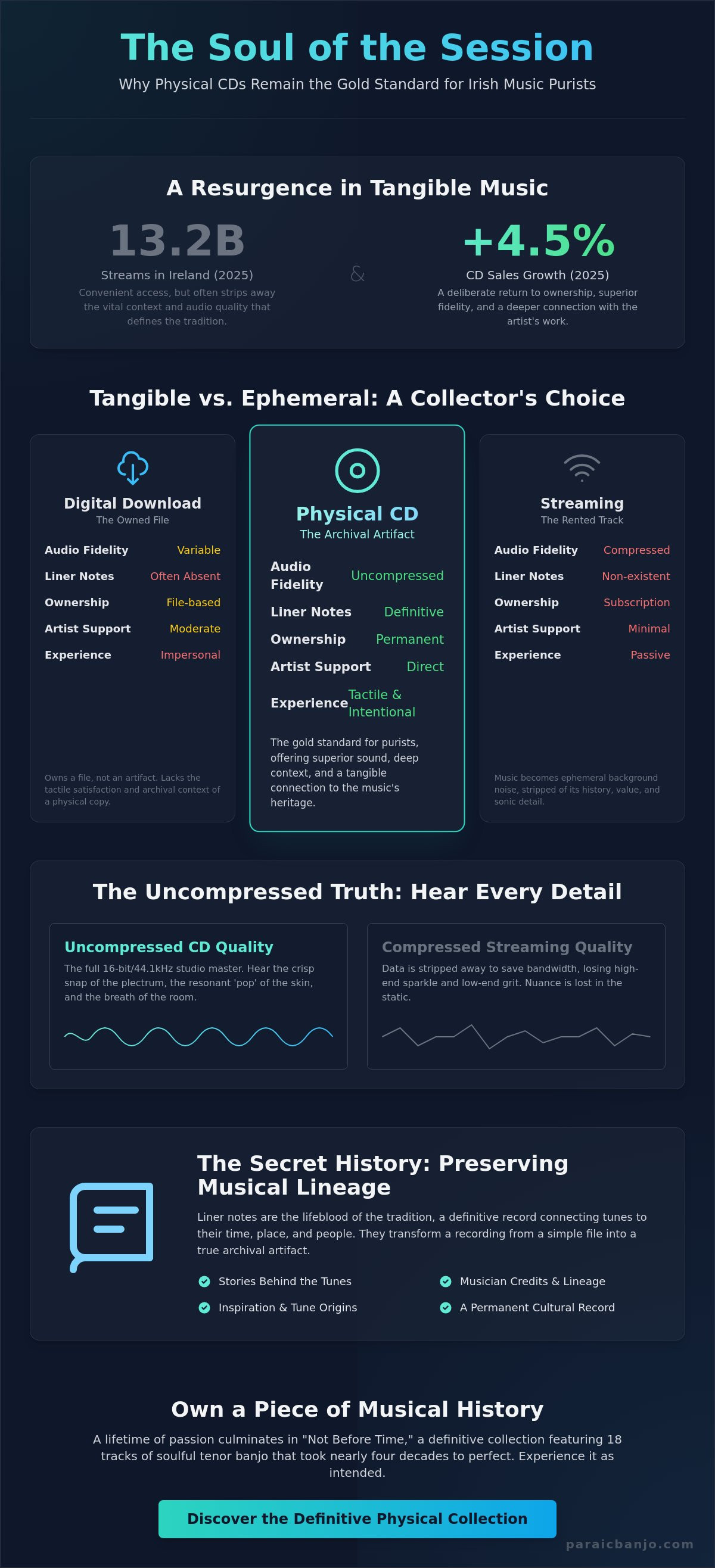
Physical CD vs. Digital Download vs. Streaming
Choosing how to consume your tunes is a choice about your values as a listener. When you invest in a physical copy irish music, you’re making a deliberate move toward longevity. Streaming is essentially a lease. You pay a monthly fee for the right to listen, but the moment that subscription lapses, your library vanishes. It’s a temporary arrangement that lacks the soul of true ownership. A physical CD is a permanent acquisition. Over a lifetime, the "cost per listen" of a disc you own outright drops to nearly zero, while a streaming service only gets more expensive. This sense of permanence is vital for our culture, as highlighted in this Traditional Irish Music overview from the Boston Public Library. We value things that last. We value the artifacts that we can hand down to the next generation of players.
There’s also a technical and environmental side to this debate. While manufacturing a physical disc has an initial footprint, the massive, non-stop energy required to maintain global data servers for streaming is a significant hidden cost. For the collector who wants a "set it and forget it" library, the CD is the cleaner, more reliable choice. It doesn't require a high-speed connection or a data plan. It just requires a player and a bit of time to sit and listen. It’s about finding that perfect balance between the portability we need and the permanence we crave.
The Collector’s Choice Matrix
Ownership is the primary differentiator. Do you actually own the music, or are you just borrowing access? When you buy a physical copy irish music, you own the bits, the booklet, and the history. Then consider the artist support. To earn the same revenue as a single CD sale, an artist often needs thousands of streams. If you want to see the tradition thrive, the math is simple. Finally, discovery through a curated album is a different beast than a cold algorithm. An album is a journey with a beginning, middle, and end, hand-picked by the performer to tell a specific story.
Why Hybrid Collections are Winning in 2026
Many of us don’t choose just one path. We buy the CD for the shelf and the high-quality digital tracks for the commute. It’s the best of both worlds. Limited edition physical runs are even becoming investment pieces for serious collectors who recognize the rarity of independent pressings. If you’re looking to expand your library with something substantial, checking out a traditional irish session music cd is a great way to start building a collection that holds its value. It’s about the joy of the hunt and the relief of knowing your favorite sets are safe on your shelf. You can enjoy the convenience of a digital file while keeping the heart of the music in a physical format that never expires.
How to Evaluate an Irish Music Physical Copy
When you're looking to add to your collection, you have to look past the shiny cover. A truly great physical copy irish music needs to capture the "Live Energy" of a session rather than the over-sanitized, clinical feel of a modern pop studio. Traditional music is a social art; it’s meant to have a bit of dirt under its fingernails. When you listen, you should hear the plectrum’s snap and the rhythmic lift that makes you want to tap your feet. If a recording sounds too perfect, it’s often lost its soul. You want to feel like you’re sitting in the corner of a warm pub in East Galway, not listening to a computer-generated loop. A masterfully produced album will preserve those subtle variations in tempo and the natural "breath" between the tunes in a set.
The tracklist is another vital marker of quality. A balanced collection shouldn't just be a long string of fast reels. You’re looking for a thoughtful mix that shows the player's depth and range. A proper album should include:
Driving Reels: The heartbeat of any session, showing off technical precision and speed.
Lift-filled Jigs: Capturing that bouncy, triple-time energy that defines the Irish dance tradition.
Stately Hornpipes: Where the "swing" and the rhythmic pulse of the East Galway style really shine.
Don't forget to check the guest list. Traditional music is a collaborative effort. A high-quality physical release will proudly feature the names of the fiddlers, flute players, or accompanists who joined the session. It shows a respect for the community and a commitment to the "Who, Where, and When" we discussed earlier. If an artist is a recognized master of their instrument, they won’t be afraid to share the spotlight with other talented performers.
The Authenticity Checklist
Before you commit to a purchase, run through a quick mental checklist. Was the album recorded "as it happened" with musicians playing together in the same room? This creates an interplay that over-dubbing simply can't mimic. Does the packaging offer more than just a list of names? You want a project that feels like a definitive statement of a lifetime's passion. Finally, look for regional markers. If you’re a fan of the banjo, you want to hear that specific East Galway pulse—a relaxed, soulful rhythm that prioritizes melody over raw speed. It’s a relief to find a recording that stays true to its roots.
Supporting Independent Releases
It’s always best to avoid the mass-produced, generic "Celtic" compilations you find in airport gift shops. These are often hollow and lack the cultural depth of a true independent release. Buying a physical copy irish music directly from an artist’s store ensures that your support goes straight to the person who spent decades honing their skill. It also guarantees you're getting the highest quality pressing and the most complete version of the liner notes. For more tips on building a library you can be proud of, you can check out this guide on how to buy traditional irish music with confidence. If you're ready to experience a recording that checks every box for authenticity and rhythmic soul, you can order your copy of 'Not Before Time' now and hear the difference for yourself.
Not Before Time: The Definitive Physical Collection
After nearly four decades of quiet practice, session playing, and honing a specific rhythmic pulse, the moment has finally arrived. It’s a relief to share this work. For those who have followed the journey, owning a physical copy irish music like "Not Before Time" isn't just about the audio. It’s about holding a piece of a 39-year legacy in your hands. This debut album isn't a rushed studio project; it’s a carefully curated masterclass in the East Galway style of tenor banjo. With 18 tracks that range from driving reels to soulful hornpipes, the recording captures the very essence of a tradition that takes a lifetime to truly understand. This limited-edition physical format is the only way to experience the full depth of the project, ensuring that the plectrum’s snap and the resonant pop of the banjo skin are preserved exactly as they were intended to be heard.
The decision to release this collection on CD was deliberate. In a world of fleeting digital files, we wanted to create something substantial. This recording serves as an archival artifact, a benchmark for the rhythmic soul of the instrument. It’s about providing a permanent home for these tunes on your shelf. Every track features the collaborative energy of world-class performers, creating a sound that feels like a warm, inviting session in a crowded kitchen. You aren't just buying an album; you're joining a storied musical tradition that has been decades in the making.
A Labor of Love and Time
The title "Not Before Time" carries a lot of weight. It’s a nod to the long road it took to get these tracks recorded and a celebration of the patience required to master the craft. This wasn't a project that could be finished in a year or even ten. It required the lived experience of thousands of sessions and the influence of countless mentors. The featured performers on the CD bring their own unique flavors, making every set feel fresh and alive. This recording stands as a definitive 39-year milestone in the history of Irish music, capturing a lifetime’s mastery in a single collection.
Secure Your Copy of Irish Music History
We’ve made sure that collectors around the globe can add this piece to their library with ease. You can order the physical CD for global delivery, bringing the heart of East Galway directly to your doorstep. For the modern listener who wants the best of both worlds, the digital/physical bundle is the perfect choice. You get the tactile satisfaction of the CD and the liner notes for your home collection, plus the high-quality digital tracks for your commute. It’s about ensuring the music is always with you, in whatever format serves your life best. Don't miss the chance to own this definitive statement of passion and tradition. Get your physical copy of Not Before Time here and settle in for a journey 39 years in the making. Happy listening!
Bring the Heart of the Session to Your Home
We've traveled through the history, the high-fidelity sound, and the deep-dive stories that make our music breathe. It's clear that in 2026, the digital stream is a fine tool for travel, but it can't replace the permanence of a well-curated archive. Investing in a physical copy irish music isn't just a purchase; it's a commitment to the living tradition. You're securing the "Who, Where, and When" of every tune while ensuring that the high-frequency sparkle of the tenor banjo is never lost to compression. It's a relief to know that these recordings will sit on your shelf, ready to be handed down to the next generation of players.
Now is the time to make this heritage your own. My debut project, 39 years in the making, is ready for your collection. It captures 18 tracks of authentic, rhythmic session music featuring a host of legendary collaborators. We offer worldwide shipping for collectors everywhere, so no matter where you sit, the pulse of East Galway is within reach. Order your limited-edition physical copy of Not Before Time today and join us in this lifelong celebration of the craft. Let's keep the tradition alive together. Happy listening!
Frequently Asked Questions
Why should I buy a physical copy of Irish music instead of streaming?
Buying a physical copy irish music ensures that you actually own the recording rather than just renting access for a monthly fee. Streaming platforms can remove tracks without notice; but a CD on your shelf is a permanent archival artifact. It represents a direct, tangible connection to the artist's original vision. This ownership is especially vital for traditional music where the context and history are just as important as the tunes themselves.
Do Páraic Banjo CDs include detailed liner notes?
Yes, every CD includes extensive supplementary materials that act as a secret history of the recording sessions. These notes document the lineage of each tune and the influences of the featured performers who contributed to the project. For a milestone like Not Before Time, which was 39 years in the making, these details provide an essential educational resource for anyone interested in the soulful East Galway style.
Is the audio quality better on a CD than on Spotify or YouTube?
CD audio is significantly superior because it provides uncompressed, 16-bit fidelity that streaming services often strip away to save data. When you listen to a physical copy irish music, you hear the crisp snap of the plectrum and the resonant pop of the banjo skin. These subtle auditory details are lost in the compressed files found on standard streaming tiers, making the CD the only choice for true purists.
How long does shipping take for international Irish music orders?
International shipping times vary depending on your location, but we provide worldwide delivery to ensure collectors everywhere can access the music. You should check the shipping details at checkout for the most accurate estimates for your specific region. We take great care in packaging every order to ensure your disc arrives in perfect condition; ready to join your permanent library as a definitive statement of the craft.
Can I buy a digital version if the physical CD sells out?
Yes, the digital album remains available even if the physical pressings are temporarily out of stock. We offer the full 18-track album as a high-quality digital download for those who prefer immediate access or want to listen on the go. While the physical disc is the gold standard for collectors who value the tactile experience, the digital version ensures that the music remains accessible to everyone in the community.
What makes a "limited edition" Irish music CD a good investment?
Limited edition recordings are valuable because they represent a specific, unrepeatable moment in musical history. These independent releases often become rare archival pieces that hold their value better than mass-produced compilations. For a debut that captures nearly four decades of mastery, the physical format serves as a definitive statement of a lifetime's passion; making it a prized addition to any serious traditional music collection that values authenticity.
Are there specific regional styles I should look for in physical recordings?
You should look for regional markers like the relaxed, melodic pulse of the East Galway style or the driving lift of Clare music. Physical recordings allow artists to highlight these niche styles through detailed tracklists and background information that algorithms often ignore. Identifying these regional nuances is much easier when you have the full context of a physical release; helping you understand the specific cultural roots of the tunes you love.
Does the physical CD come with a digital download code?
You should check the specific product descriptions in our store to see which bundles are currently available for purchase. We often offer the digital album alongside the physical CD to give collectors the best of both worlds. This allows you to enjoy the tactile experience of the booklet and disc at home while having the convenience of digital tracks for your daily commute or travel. It’s about keeping the music accessible everywhere.
Comments