A Selection of Traditional Irish Banjo Albums, Vocal and Instrumental

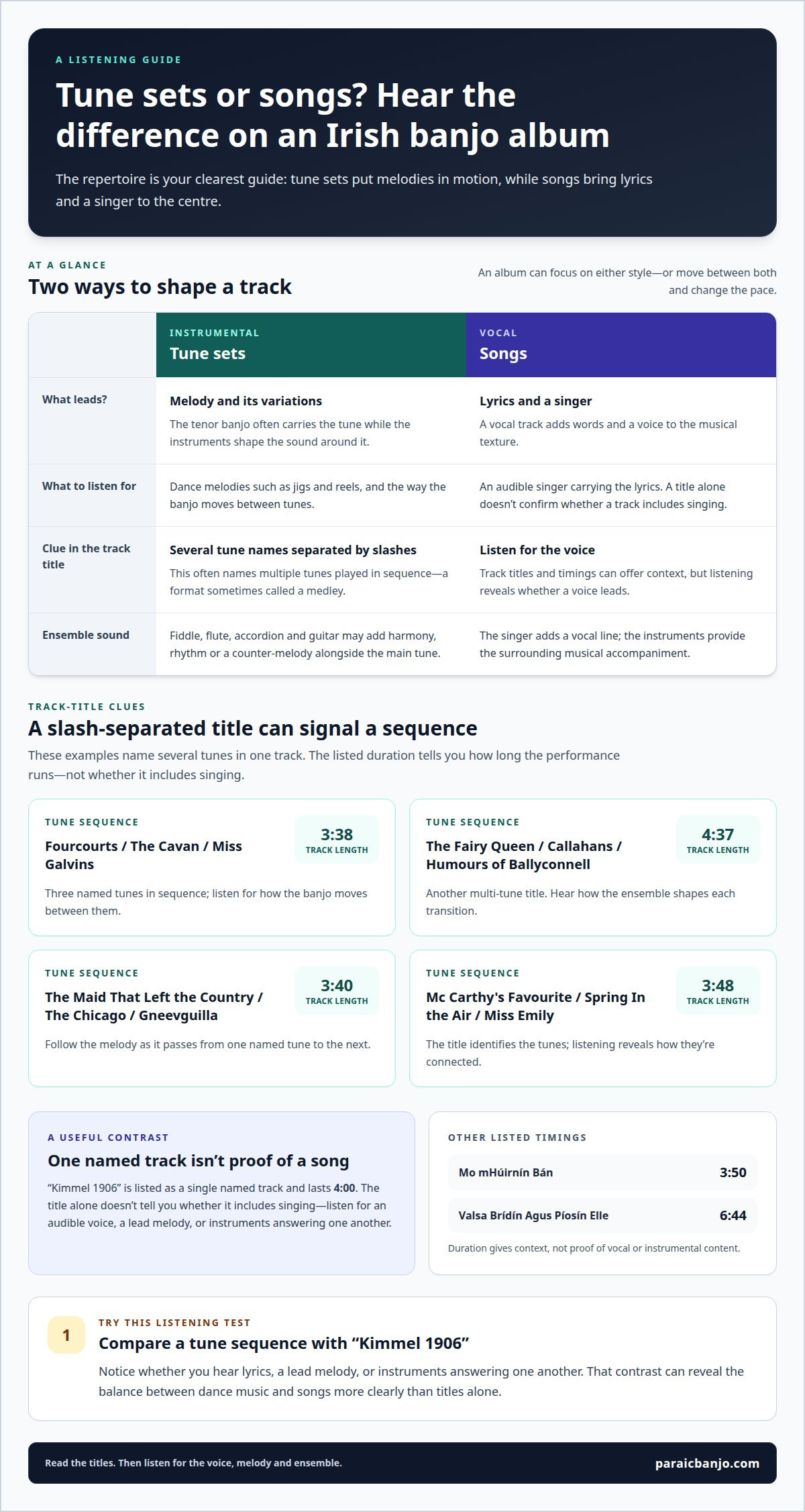
The banjo alone doesn’t tell you what an album will sound like. A traditional Irish banjo album may be instrumental, vocal, or a blend of both. Tune sets bring together dance melodies such as jigs and reels, while songs put lyrics and singing at the heart of a track. The repertoire is your clearest guide to the listening experience.
If you’re drawn to the drive of a lively session, instrumental sets may be the first tracks you reach for. If you want a melody carried by a voice, look for songs alongside the tunes. An album that moves between the two can change the pace while staying rooted in Irish tradition.
This guide explains how vocal and instrumental music differs, the tunes and songs you may encounter, and how to choose an album that suits your ear. It also looks at Páraic Mac Donnchadha’s debut recording, a collection shaped by traditional session music and the musicians who bring it to life.
Table of Contents
1. Instrumental and vocal album content
Irish banjo albums can feature instrumental tune sets, sung songs, or both. The tenor banjo often carries the melody, while fiddle, flute, accordion, and guitar add harmony, rhythm, or a second melodic line. That second line, called a counter-melody, plays alongside the main tune without replacing it. Vocal tracks add lyrics and a singer; instrumental tracks let the melody and its variations take centre stage.
Track titles offer a useful first clue. A title divided by slashes, such as “Fourcourts / The Cavan / Miss Galvins,” names several tunes played in sequence within one track. This format is sometimes called a medley. The track lasts 3:38. “The Fairy Queen / Callahans / Humours of Ballyconnell” uses the same approach and lasts 4:37.
Other examples show how several melodies can fit into a single performance. “The Maid That Left the Country / The Chicago / Gneevguilla” runs for 3:40, while “Mc Carthy's Favourite / Spring In the Air / Miss Emily” runs for 3:48. The track title identifies the named tunes; listening reveals how the banjo moves between them and how the ensemble shapes each transition.
Not every title names several tunes. “Kimmel 1906” appears as a single named track and lasts 4:00. “Mo mHúirnín Bán” lasts 3:50, while “Valsa Brídín Agus Píosín Elle” runs for 6:44. A title alone doesn’t establish whether a track includes singing. Listen to hear whether a voice, banjo, or ensemble leads.
For a practical comparison, play one sequence of named tunes, then “Kimmel 1906.” Notice whether you hear lyrics, a lead melody, or instruments answering one another. That contrast can reveal the balance between dance music and songs more clearly than titles alone.
Track length offers context, not proof of content. “Bunch Of Green Rushes / New Custom House / Pinch Of Snuff” lasts 3:25, and “Dinny Delany's / Bould Doherty / The Cow That Ate the Blanket” lasts 4:06. Those timings show how much space each performance takes on the album, but they don’t indicate whether anyone sings. Listen for the vocal line and accompanying instruments.
To focus on melody-led playing, try “Flowers Of Edinburgh / The Morning Star / Mike Healy's / Humours Of Lissadell,” which lasts 3:58. For lyrics, listen for an audible singer instead. An album containing both styles changes texture from track to track, offering two distinct ways to hear traditional Irish music.
2. Traditional Irish banjo repertoire
Irish tenor banjo repertoire centres on melodies shaped for dancing and session playing. Reels, jigs, and hornpipes each have a distinct rhythmic feel, so listen for the lift and pulse as well as the tune itself. A reel usually feels brisk and even; a jig has a lilting bounce. These differences help you hear how players shape a set.
For a first listen, choose albums with clear melodies and a steady rhythm, then follow the tune titles as you listen. Humdinger is a point of reference: it is described as the first full recording of banjo and melodeon music. Follow the banjo line, then listen again for how the melodeon answers or supports it.
Irish tenor banjo recordings and bluegrass banjo albums differ in repertoire and playing approach. Irish recordings commonly foreground dance-tune melodies, often played on the four-string tenor banjo. Bluegrass frequently features the five-string banjo and a more prominent picking pattern, with the instrument providing rhythmic drive as well as melody. Compare a track from each style and listen for the banjo’s role in the ensemble.
How much do Irish banjo albums cost? Prices depend on the format and seller, and digital albums and physical CDs may be priced differently. Compare the format and contents you want rather than assuming every release costs the same.
Where can you stream or buy traditional Irish banjo albums? Streaming depends on which platforms carry a particular recording; digital albums can also be purchased directly from the artist’s site. For a recording rooted in Irish session music, Not Before Time - 39 Years in the Making is available as a digital album.
To explore a repertoire actively, choose a track and note its tune names, rhythm, and instrumentation. Replay it while focusing on one instrument. This simple listening method can reveal how a melody develops and how the ensemble keeps its dance pulse.
On a traditional Irish banjo album, the repertoire may move between lively dance sets and other traditional material. Listen for changes in tempo, melodic shape, and accompaniment. These details help distinguish one performance from another, even when both recordings draw on the same broad tradition.
3. What are the best traditional Irish banjo albums?
The right recording depends on what you want to discover. Some listeners value a strong ensemble sound, where musicians shape the music together. Others want to focus on one player’s touch, timing, and melodic choices. Rather than treating “best” as a fixed ranking, decide what you hope to hear, then judge each recording against that purpose.
For a sense of the ensemble, notice how the musicians respond to one another. A performance can feel cohesive when the accompaniment supports the banjo without crowding its melody. Listen for shifts in energy, changes in dynamics, and moments when another instrument adds colour. These details reveal musical conversation, not just individual technique.
If you’re exploring a player’s style, pay attention to phrasing: the way a musician shapes and connects notes to give a tune its character. A player might lean into a note, leave a little space, or add a variation. These choices can make familiar traditional material sound personal without losing its dance pulse.
Use these criteria to build a shortlist that fits your interests:
Ensemble sound: Choose a recording where the balance between lead and accompaniment feels engaging to you.
Playing character: Notice the player’s tone, timing, and approach to shaping melodies.
Listening purpose: Decide whether you want an enjoyable session atmosphere, close attention to technique, or both.
Context: Consider whether background notes help you understand the musicians and their musical choices.
A recording that suits an experienced listener may not be the easiest starting point for someone new to Irish traditional music. If the playing feels dense, focus on one element at a time, such as the banjo’s tone or the ensemble’s rhythmic feel. If you already know the style, listen for subtler details, including how the musicians shape repeated phrases.
Keep a short listening note after each album. Record what stood out, such as the ensemble’s warmth, the lead player’s phrasing, or the performance’s mood. This gives you a personal basis for comparison instead of relying on a universal “best” label. The most rewarding recording is the one that keeps drawing you back and gives you something new to hear.
4. Which albums feature Irish tenor banjo music?
Recordings featuring Irish tenor banjo are easy to explore by looking up the musicians named in the credits. Enda Scahill is one prominent player: he is a four-time All Ireland Champion banjo player from Corofin, County Galway. His name offers a starting point for exploring Irish banjo recordings. Notice whether an album presents a player as the lead artist or credits them within a larger group.
A musician’s background can add context to a recording, though it won’t tell you exactly what the music sounds like. Scahill began playing music at six and practised banjo for an hour or more a day as he learned. That long apprenticeship offers context when listening for precision and control. Focus on the player’s attack, note clarity, and how confidently each phrase sits within the performance.
Album credits help distinguish a banjo-focused release from a broader traditional music collection. Look for the banjo player’s name alongside the other musicians, then consider how the album is presented. A release centred on one player offers a different way into the music than a group recording where several performers share the spotlight. Credits establish who is playing; the track itself reveals the performance’s character.
To explore a player’s recorded work, use a simple discovery path:
Start with a named musician. Search album listings for an Irish banjo player such as Enda Scahill.
Read the artist billing. Distinguish a solo-led release from an album credited to an ensemble.
Follow the personnel. Note which other musicians appear alongside the banjo player.
Compare the settings. Notice how the same player’s approach comes across in different ensemble contexts.
This approach helps you find recordings by musician, not just by instrument label. It can also reveal connections among players and collaborators. If a banjoist’s name appears with different accompanists, compare how the surrounding ensemble changes from one recording to another. Treat each album as a musical snapshot shaped by its players and setting.
Scahill’s early start and sustained daily practice offer one biographical lens for hearing a seasoned player, but they don’t replace listening. Once you find a recording associated with an Irish tenor banjoist, consider what you want from it: a close encounter with one player’s style or a sense of how that player contributes to a group. That distinction makes your next album choice more deliberate.
Enda Scahill is identified as a prominent Irish banjo player and a four-time All Ireland Champion.
5. What are recent traditional Irish banjo albums?
To identify recent recordings, distinguish an album’s release date from its recording date. A session recorded earlier may be newly released, while a reissue may bring older material back into circulation. Check album details for both dates when available. This distinction helps you find new listening without mistaking a fresh reissue for a newly recorded performance.
Artist releases can reveal where a recording sits in a musician’s work. Enda Scahill, for example, is a named Irish banjo player whose recordings offer a way to explore his playing. Look at album credits and release information together. A recent release by an established player may document a new project, a different ensemble, or another selection of traditional material.
Pay attention to recording context, too. A live album captures musicians playing together in the moment, while a studio recording can present a more controlled arrangement. The label “live” doesn’t tell you when the performance happened. Read the accompanying notes for context, then listen for the interaction between the banjo and its fellow musicians.
Use this short checklist to assess a release:
Find the release date. Separate the original release from a later reissue or digital edition.
Read the credits. Identify the banjo player and the other musicians featured on the recording.
Check the track list. Look for tune names, songs, and any indication of a live performance.
Listen to a full track. Hear how the banjo sits in the arrangement, not just in a short preview.
Album details can make two recordings with similar repertoire feel quite different. The credits might show a solo-led performance in one case and a group session in another. The track list can reveal whether the album focuses on linked tunes or moves among different kinds of material. Those specifics give “recent” a useful musical context instead of making date the only reason to listen.
For a wider historical perspective, Humdinger is described as the first full recording of banjo and melodeon music. Its place in recording history differs from that of a newly issued album, but it offers a reference for hearing that instrumental pairing. Compare the date and context of any newer release with its credits and sound, rather than relying on a “new” label alone.
Once you’ve found a release that interests you, note its date, players, and recording setting before choosing a track. To continue exploring Irish session recordings, explore a traditional session album.
Páraic Banjo: Not Before Time - 39 Years in the Making (Digital Album)
Not Before Time - 39 Years in the Making brings traditional Irish session music into a live recording shaped by Páraic Mac Donnchadha and fellow musicians. Its 18 tracks offer a substantial listen for anyone exploring banjo-led Irish music and the interplay of an expert ensemble.
Choose the digital album to hear the collection as a complete work, or explore individual digital tracks. A physical CD is also available for listeners who prefer a tangible album. The recording’s live setting lets you experience the musicians playing together, with the energy and character that gives session music its distinctive feel.
Explore “Not Before Time” on Páraic Banjo’s website, where the album and individual digital tracks are available.
Let the music guide your next listen
Choose a listening route that follows your curiosity. Start with a melody that catches your ear, then return to it and notice what you missed: a change in phrasing, a rhythmic lift, or another instrument answering the banjo. Repeat listening turns a traditional Irish banjo album into more than background music. It becomes a doorway into the musicians’ choices and the tradition they carry forward.
You don’t need to know every tune name before pressing play. Let the sound lead, then follow the details that make you want to listen again. If you’d like to explore Páraic Banjo’s recording or ask about the album, contact Páraic Banjo.
Take your time with the music, trust your ear, and enjoy the journey.
Frequently Asked Questions
What are essential classic Irish banjo recordings?
Essential listening depends on whether you want a live ensemble sound or a closer study of tune playing. BEO is a live album featuring Páraic Mac Donnchadha with piper Padraig Keane, bouzouki player Macdara Ó Faoláin, and bodhrán player Jimmy Higgins. Listen for how the banjo shares space with pipes, bouzouki, and bodhrán. This combination offers a vivid example of Irish traditional musicians performing together.
How much do traditional Irish banjo albums cost?
Prices depend chiefly on the format and seller; digital albums and physical CDs may be priced differently. Compare the format and contents offered.
Comments