Buy Tenor Banjo Music: The Ultimate Collector’s Guide for 2026

What if the most polished recording in your collection is actually the one you enjoy the least? It is a common trap for many collectors today. You set out to buy tenor banjo music only to end up with a studio-scrubbed track that has lost the raw, driving pulse of a real Irish session. You want the grit, the lift, and the stories behind the strings; you don't want a sanitized version of a living tradition that feels more like a computer than a craftsman. Finding those independent gems that carry the weight of a lifetime’s passion can feel like a daunting task in a sea of digital files.
I know that feeling of searching for the "real" thing because I have spent 39 years honing this craft to ensure the music stays alive. This guide will show you exactly how to find, evaluate, and buy authentic Irish tenor banjo recordings that capture the true spirit of traditional music. We will look at why detailed liner notes are essential for context and how you can support independent artists directly. If you want a definitive statement of a legendary journey, you can order the Not Before Time physical CD or download the digital album to hear that session energy for yourself. Let's build a collection that actually breathes.
Key Takeaways
Master the art of finding the "pulse," that infectious rhythmic drive rooted in dance that makes a banjo track feel alive rather than just played.
Understand the technical trade-offs between physical CDs and digital files to ensure you get the best audio quality when you buy tenor banjo music.
Spot authentic session energy by looking for recordings where the interaction between musicians hasn't been scrubbed away by modern studio tricks.
Start your collection with a strategic mix of spirited reels and melodic jigs to represent the true breadth of the Irish musical landscape.
Learn why buying direct from the creator is the best way to secure exclusive liner notes and background stories that aren't available on major streaming platforms.
Table of Contents
Finding the Pulse: Why Buy Tenor Banjo Music in 2026?
Irish tenor banjo music isn't just a collection of notes on a page. It is a rhythmic, soulful genre that finds its roots in the dusty floors of dance halls and the crowded corners of village pubs. When you hear a reel played right, you don't just hear the melody; you feel the "pulse." This is the unique rhythmic drive, that internal engine that separates a technically perfect player from one who truly understands the tradition. It's why so many enthusiasts choose to buy tenor banjo music from independent artists rather than settling for generic, mass-produced folk compilations. It is about the lift, the swing, and the shared breath of the musicians in the room.
In 2026, we are seeing a massive revival in independent traditional music releases. Listeners are tired of the over-produced studio sound. They want something real. My own project, Not Before Time, stands as a benchmark for this movement. It took 39 years to bring this collection to life, and that weight of time is audible in every pluck of the string. It isn't just an album; it's a definitive statement of a lifetime’s passion for the craft. A relief to finally share. A celebration of the music that defines us.
The Appeal of the Four-String Sound
The tenor banjo has a bright, punchy voice that cuts through the din of a busy session. Bright. Punchy. Unmistakable. While the history of the tenor banjo shows its roots in various genres, the Irish style relies heavily on the GDAE tuning. This tuning, set an octave below the fiddle, allows the banjo to mirror the fiddle’s range while adding a percussive edge. This specific setup is essential for that authentic session feel. It transformed the instrument from a rhythmic interloper into the very heartbeat of the Irish session, providing a foundation that drives the dancers and the other players alike.
Why Listening is the Best Way to Learn
Pure lifted energy. If you want to understand the soul of this instrument, you have to listen. Truly listen. Ear training is the secret weapon of every great musician. By studying the work of masters like Páraic Mac Donnchadha, you can begin to internalize the nuances that notation simply cannot capture. For example, if you are drawn to the East Galway style, you'll notice a slightly more relaxed pace and a focus on melodic flow that requires a very specific rhythmic touch. When you buy tenor banjo music that was recorded with this educational mindset, you're not just getting a song; you're getting a masterclass in style.
Here is a practical tip for your next listening session: don't just focus on the lead melody. Try to tap out the underlying rhythm of a hornpipe or a jig. Use professional recordings to internalize these regional variations. This deep immersion is the only way to develop a genuine feel for the "lift" in the music. You can Discover the soul of the banjo in "Not Before Time" by exploring the physical CD or the digital album. For those who want to focus on specific tunes, individual digital tracks are also available to help you build your collection one reel at a time. Let's keep the tradition moving together.
Digital Downloads vs. Physical CDs: Which Format Fits Your Collection?
Deciding how to buy tenor banjo music often comes down to how you want to interact with the tradition. Digital downloads offer undeniable speed. You can have a new set of reels in your ears within seconds. However, for many collectors, a digital file lacks the weight of a physical connection. There is a specific kind of magic in holding a project that took 39 years to reach your hands. Whether you are a minimalist or a curator of physical media, the format you choose shapes your relationship with the tunes and the history of Irish traditional music.
The choice isn't just about shelf space; it is about the story. A physical CD serves as a limited edition piece of history, especially for a debut album like Not Before Time. It marks a significant career milestone that I am finally able to share. On the other hand, digital track selection gives you the flexibility to build custom "session" playlists, perfect for those who want to focus on learning specific jigs or hornpipes at their own pace. If you're ready to start your journey, you can browse the full collection to see which format suits your listening habits best.
The Case for the Physical CD
Owning the physical CD is about the full experience. It features 18 tracks that span nearly four decades of musical growth. You get the tactile satisfaction of the sleeve and, more importantly, the detailed liner notes. These notes provide the essential context for each set, explaining where the tunes came from and the stories of the musicians who passed them down. Actionable tip: always look for "limited edition" tags when you buy tenor banjo music. These physical copies often hold more value for collectors and offer a deeper educational resource than a bare digital file. It’s a definitive statement of a lifetime's passion that you can keep on your shelf forever.
High-Quality Digital Downloads
If you prefer the digital route, don't settle for low-quality audio. Banjo music relies heavily on "transients," which is just a fancy way of describing the sharp, immediate "pluck" sound of the plectrum hitting the strings. Low-bitrate MP3s often muddy these sounds, making the banjo lose its characteristic crispness. To capture the true energy of a session, always look for WAV or FLAC files. High-Quality Audio: Why Digital Track Selection Matters because it ensures you hear every ornament and rhythmic nuance exactly as it was played in the studio. You can opt for the full digital album for immediate access or pick out individual digital tracks to start building your repertoire today. It’s about getting the music into your life without delay.
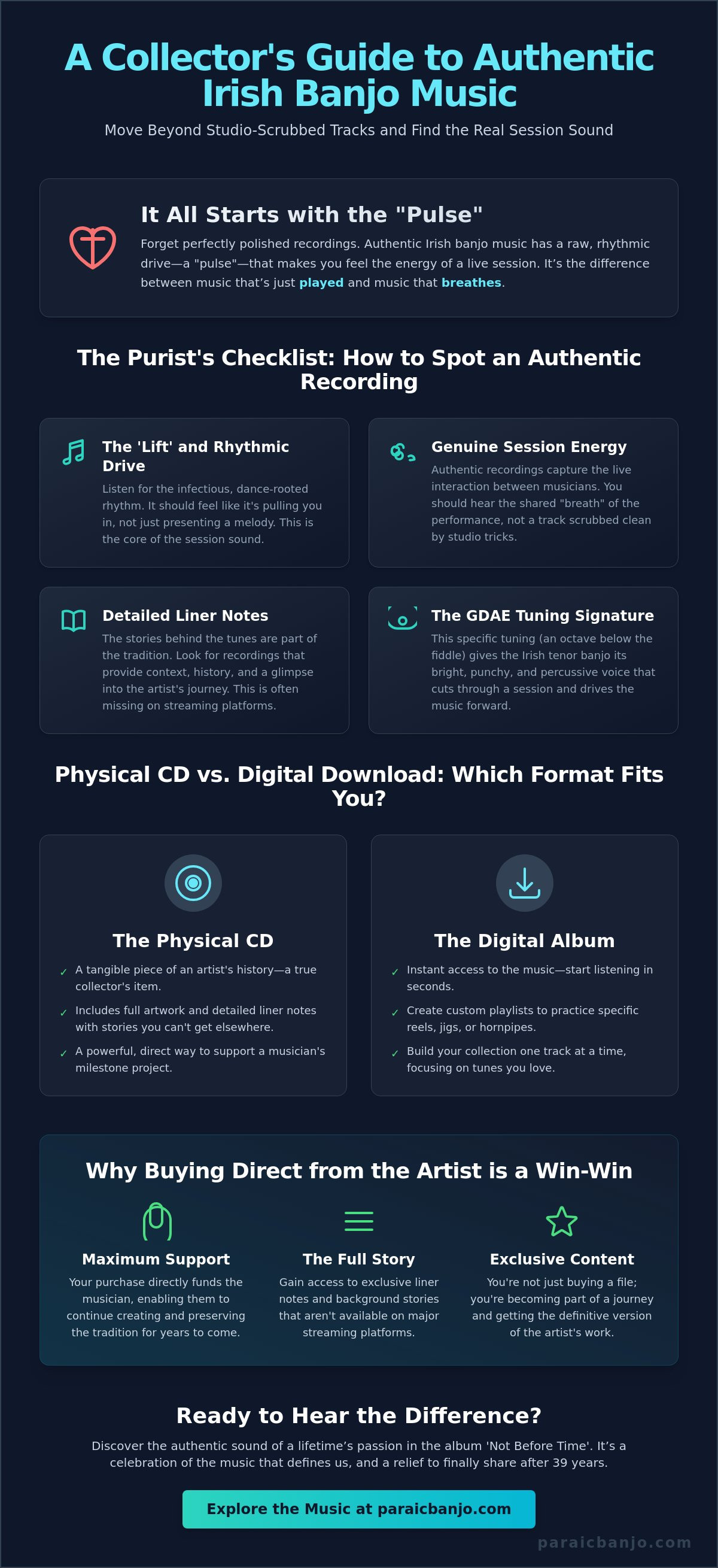
The Purist’s Checklist: How to Spot Authentic Irish Banjo Recordings
Some people think all Irish music sounds the same. It doesn't. If you have spent any time in a crowded pub in Galway or Clare, you know that the music is a conversation, not a monologue. When you set out to buy tenor banjo music, you aren't just looking for a melody; you are looking for "Live Energy." This is the audible spark that happens when musicians react to one another in real time. It is the subtle hesitation before a turn or the shared drive into a new reel. If a recording feels too sterile or perfectly timed to a click track, it has likely lost its soul. Authentic recordings prioritize the raw, honest sound of the plectrum hitting the strings over studio-scrubbed perfection.
The "No Over-Production" rule is vital for the tenor banjo. This instrument needs air. It needs to breathe. You should hear the grit of the performance and the resonance of the wood. A truly authentic album also respects regional styles. There is a world of difference between the relaxed, melodic flow of East Galway and the steady, rhythmic pulse of Clare. Identifying these nuances is what makes a collection stand out. If you want to dive deeper into these distinctions, check out How to Buy Traditional Irish Music: A Collector’s Guide to Authenticity for a more detailed breakdown of what to look for.
Rhythm and Soul over Speed
Fast is easy. Soul is hard. In traditional circles, we often see players who try to mask a lack of rhythm with sheer velocity. Don't be fooled. When you buy tenor banjo music, listen for the "swing" in the reels and the "lift" in the jigs. My own style has always focused on the rhythmic soul of the instrument rather than just playing as many notes as possible. Actionable tip: listen to the first ten seconds of a track. If you don't feel an immediate urge to tap your foot, the "pulse" isn't there. Authentic music should make you want to move.
The Importance of Accompaniment
The banjo doesn't live in a vacuum. Its relationship with the guitar or piano is what creates that wall of sound we love in a session. Look for albums that feature expert collaborators who understand how to support the banjo’s bright transients without over-powering them. On Not Before Time, I worked with musicians who have spent decades mastering this delicate balance. A great recording highlights this interaction. It shows the banjo as part of a community. If you are looking for that complete session sound, you can pick up the physical CD or the digital album to hear how these instruments weave together. Individual digital tracks are also a great way to hear specific pairings of banjo and accompaniment.
Curating Your Library: Choosing the Best Reels, Jigs, and Hornpipes
Building a library isn't just about filling space on a hard drive or a shelf. It's about curation. When you set out to buy tenor banjo music, you're looking for a balance of energy and melody that fits the different moments of your life. In the Irish tradition, we rarely play a single tune and stop. We play "sets." A set is usually two or three tunes played back-to-back, where the energy builds from one to the next. This creates a narrative arc that single tracks often miss. My debut album, Not Before Time, features 18 tracks designed to take you on this exact journey, moving through decades of tradition in every set.
Actionable tip: if you're just starting your collection, aim for a "balanced diet." Pick three high-energy reel sets for when you need a lift, and three melodic jig sets for a more relaxed atmosphere. Using specific tracks for different moods is a pro move for any collector. Driving down a long road? Put on a set of driving reels. Sitting down to study or read? A slower hornpipe or a melodic jig provides the perfect background without being distracting. You can grab the full digital album to ensure you have the right "vibe" for every occasion.
Essential Tune Types for Beginners
Reels: These are the 4/4 heartbeat of the session. They are fast, driving, and full of lifted energy. If you want to feel the "pulse" we talked about earlier, reels are where you'll find it most clearly.
Jigs: Defined by a bouncing 6/8 rhythm, jigs are the quintessential dance tunes. Think of the rhythm as "ham-and-eggs, ham-and-eggs." They offer a lighter, more playful feel than reels.
Hornpipes: These are slower and more syncopated. They are often used as "showcase" tunes because the slower tempo allows the banjo's punchy transients to really shine. They have a distinct "cluck" that is incredibly satisfying to hear.
Building a Story-Driven Collection
The best music comes with a pedigree. In our community, we don't just play a tune; we talk about who we learned it from. This musical lineage adds a layer of depth to your library that you won't find in generic digital files. When you buy tenor banjo music that includes detailed liner notes, you're buying into a 39-year-old story. You learn about the masters who passed these tunes down through the generations. For a deeper look at why this matters, read my post on Exploring the Best Traditional Irish Session Music CDs for Collectors in 2026. Understanding the history makes the listening experience personal. It turns a digital track into a definitive statement of a living tradition.
Supporting the Tradition: Why Buying Direct from the Artist Matters
Buying music today often feels like a faceless transaction. You click a button on a massive streaming platform and the artist receives a tiny fraction of a cent. When you choose to buy tenor banjo music directly from the creator, you change that dynamic entirely. The artist-direct model ensures that the resources go straight back into the craft. This support is what allows independent releases to thrive. Unlike mass-market compilations that often prioritize quantity over soul, an independent release is a curated labor of love. It represents the grit and the lift of a real session. It's a relief to finally share these 18 tracks after 39 years of preparation, knowing they are going to listeners who truly value the pulse of the instrument.
By purchasing direct, you also become a vital part of preserving regional musical traditions. Whether it is the melodic flow of East Galway or the rhythmic drive of Clare, these styles live on through the people who listen to them. Independent releases are almost always higher quality because the artist has total control over the sound. When you buy tenor banjo music from an independent source, you aren't getting a sanitized, radio-friendly version of a tune. You're getting the raw, honest plectrum work that defines our community. It’s a definitive statement of a lifetime’s passion, and it belongs in a collection that respects that history.
The Personal Connection
The direct-to-consumer model isn't just about the transaction; it's about the relationship. When you buy from my site, you're connecting with a storied tradition and a community of performers who value collaboration. I want you to feel like you're being invited into the session. Actionable tip: sign up for artist newsletters. This is the best way to get early access to limited physical runs or special edition releases before they sell out. You can support the tradition and order Not Before Time directly from Páraic to ensure you get the most complete version of this project, including all the background notes that bring the music to life.
Making the Purchase: What to Expect
The process is designed to be as smooth as a well-played reel. If you choose the digital album or individual digital tracks, you'll receive high-quality files instantly. No waiting. No fuss. For those who prefer the tactile experience, global CD shipping is handled with care to ensure your physical copy arrives safely. Every transaction is secure. The files are delivered in formats that preserve those essential banjo transients we discussed earlier. For a deeper look at the logistics, check out The Collector’s Guide: How to Buy Traditional Irish Music Direct from Artists in 2026. It's about making sure the music gets from my hands to yours without anything getting lost in translation. Let's keep these tunes moving together.
Take the Tradition Home
You've seen how the right format and a sharp ear for the "pulse" can transform your collection from a list of files into a living history. Remember to prioritize high-quality audio and look for that raw, unpolished session energy that defines our community. Whether you prefer the immediate access of a download or the tactile depth of a physical disc, the most important step is connecting directly with the source. This ensures the stories and the spirit of the music remain intact for the next generation of listeners.
When you choose to buy tenor banjo music that carries the weight of a 39-year journey, you aren't just a listener; you are a guardian of the East Galway and Clare traditions. My debut project, Not Before Time, offers 18 tracks of pure session energy, captured exactly as it should be. The physical CD even includes detailed liner notes to guide you through the history of every set. It’s a relief to finally share this milestone with you. Order "Not Before Time" – The Definitive Tenor Banjo Album and bring the heartbeat of the session into your own home. Let's keep the music moving.
Frequently Asked Questions
Is it better to buy a digital album or a physical CD for Irish banjo music?
It really comes down to how you want to experience the tunes. If you want the music right now, the digital album is your best bet; it's fast and lets you start listening instantly. However, if you value the history behind the 18 tracks on Not Before Time, the physical CD is the definitive choice. It includes detailed liner notes that act as a map for the session, giving you the stories that digital files often leave behind.
What is the difference between "standard" and "Irish" tenor banjo tuning in recordings?
The primary difference is the pitch and the cultural feel. "Standard" tuning (CGDA) is common in jazz, while "Irish" tuning (GDAE) is set an octave below the fiddle. This lower tuning is essential for the authentic session sound because it allows the banjo to mirror the fiddle's range while adding a punchy, percussive drive. When you buy tenor banjo music specifically for traditional Irish sessions, make sure it's recorded in GDAE to get that true regional flavor.
Can I buy individual tracks or do I have to purchase the full album?
You can absolutely purchase individual digital tracks if you're looking to learn a specific reel or jig. This is a great way to build a custom "session" playlist or focus on a particular set that caught your ear. While the full album offers the most complete narrative of this 39-year project, individual tracks give you the flexibility to curate your own library one tune at a time.
How do I know if a tenor banjo recording is "authentic" session music?
Authenticity is all about the "pulse" and the interaction between players. Listen for recordings that haven't been scrubbed clean by over-production; you should hear the raw energy and the lift in the rhythm. If the music makes you want to tap your foot immediately, it’s a good sign. When you buy tenor banjo music, look for that feeling of a conversation between the banjo and the accompaniment, rather than a sterile solo performance.
What are liner notes and why do they matter when buying traditional music?
Liner notes are the informative background notes included with a CD that explain the history and lineage of the tunes. In traditional music, knowing who a tune was learned from is as important as the melody itself. These notes provide the context that turns a track into a piece of history. A practical tip is to read the notes while listening to understand the regional styles and the stories of the masters who passed these sets down.
How does buying direct from the artist help the Irish music community?
Buying direct ensures that more of the revenue goes straight to the creator rather than being lost to large streaming platforms. This support allows independent artists to continue recording and preserving niche traditions like the East Galway and Clare styles. It’s a way to invest in the future of the music while securing the highest quality version of the work for yourself. You can order the album directly to help keep these traditions alive.
Will I receive my digital download immediately after purchasing?
Yes, your digital download is available the moment your transaction is complete. You don't have to wait for a physical package to arrive to start internalizing the rhythms of the sets. This immediate access is perfect for musicians who want to start practicing along with the tracks or for listeners who can't wait to hear the 39 years of mastery captured in this debut collection.
Does Páraic Mac Donnchadha ship physical CDs internationally?
We certainly do ship physical copies of Not Before Time to listeners all around the globe. Whether you are in Ireland or overseas, you can have the physical CD and its extensive liner notes delivered to your door. It’s important to us that this milestone reaches the entire traditional music community, regardless of where you call home. Simply select the physical CD option at checkout to get your copy moving.


Comments