Irish fiddle and banjo duets: albums and recordings to hear

The fiddle and tenor banjo can make a traditional tune sound both driving and richly melodic. Irish fiddle and banjo duets are especially rewarding for the way the instruments trade phrases, lock into a rhythm, and bring fresh energy to familiar dance tunes. Across the Pond features fiddle and banjo throughout, while recordings by Johnny Cronin and Joe “Banjo” Burke offer another pairing to explore.
Recordings that feature both instruments clearly can take some digging to find, especially when they sit among larger ensembles. This guide points you toward duet albums and traditional recordings, introduces musicians associated with the sound, and offers practical ways to search for the music. You’ll also learn what to listen for: the fiddle’s lift and ornamentation, the banjo’s crisp pulse, and the interplay that brings a session tune alive. Start with a recording that catches your ear, then follow the musical connections.
Table of Contents
Fiddle-and-banjo duet albums
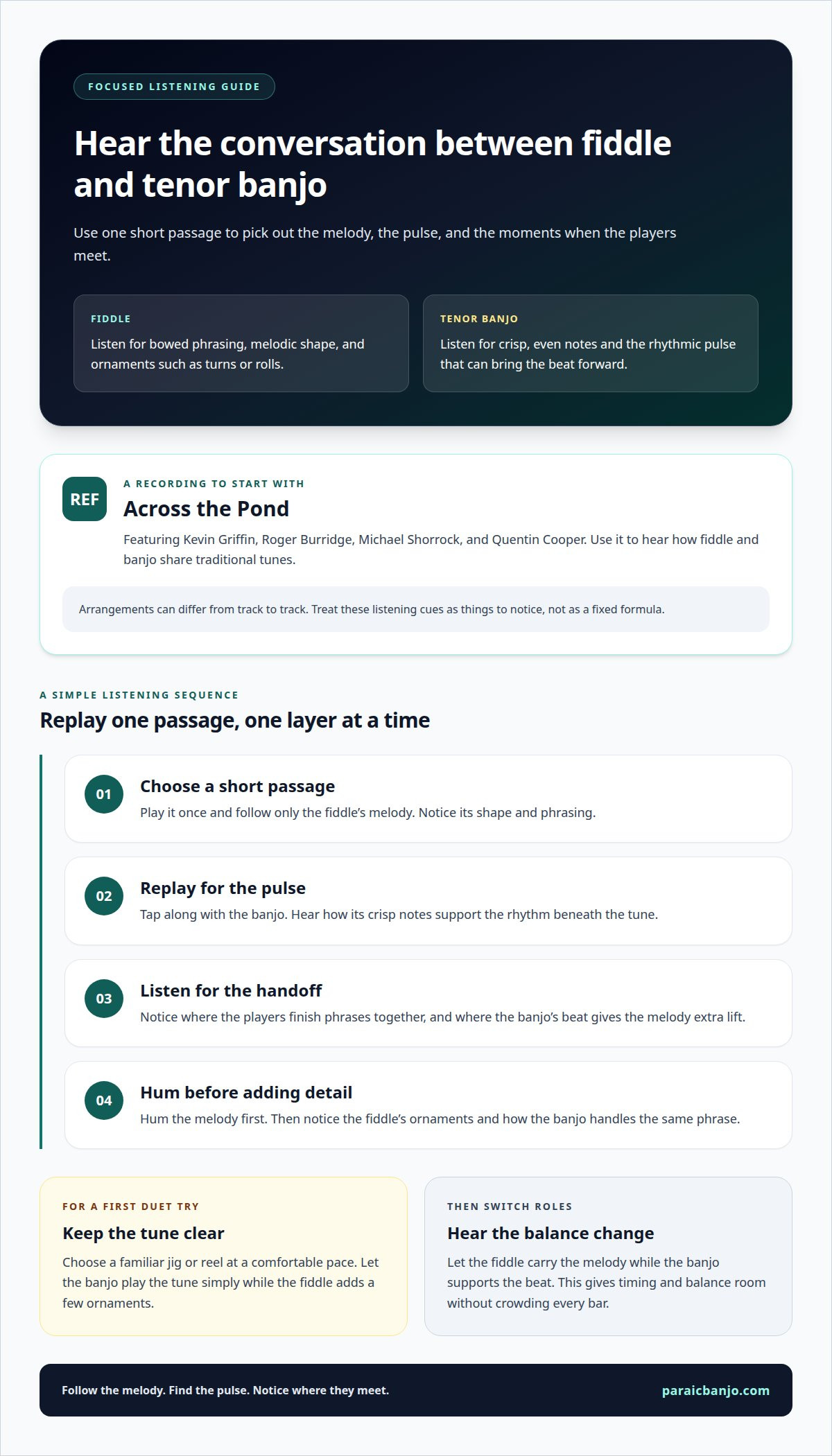
Start with Across the Pond, featuring Kevin Griffin, Roger Burridge, Michael Shorrock, and Quentin Cooper. Its fiddle-and-banjo pairing makes it a useful reference for hearing how two lead instruments share traditional tunes. Follow the fiddle’s melodic shape, then listen for the banjo’s rhythmic drive beneath it.
Rather than hearing the banjo as background accompaniment, focus on how the parts interact. The fiddle may carry the tune while the banjo supplies a clear pulse. The banjo’s attack can then bring the beat forward and give the melody extra lift. These are listening cues, not a claim that every track uses the same arrangement. Choose a tune and replay it, focusing on one instrument at a time.
Albums with a clear duet format help players hear the musical conversation between fiddle and tenor banjo. In Irish music, the tenor banjo often doubles a melody in crisp, even notes, while the fiddle ornaments it with turns or rolls. A roll is a quick flourish around a note. Compare how each player handles the same phrase, and notice where they match or vary its rhythm.
Beginner-friendly arrangements keep the melody recognizable and the accompaniment steady. Try a familiar jig or reel at a comfortable pace, with the banjo playing the tune simply and the fiddle adding a few ornaments. Then swap roles: let the fiddle carry the melody while the banjo supports the beat. This gives beginners room to hear timing and balance without crowding every bar.
For a first listening session, choose one recording and follow these steps:
Play a short passage once, listening only to the fiddle’s melody.
Replay it and tap along with the banjo’s pulse.
Listen again for places where the players finish phrases together.
Try humming the melody before adding ornamentation or faster playing.
Irish traditional sessions and concerts take place in the United States. Whether a particular event features fiddle and banjo depends on the musicians attending or performing. Look for listings that mention Irish traditional music, then see whether fiddle and tenor banjo players are named. Concert descriptions can also indicate whether the format features a small instrumental pairing or a larger group.
That distinction matters when choosing an album. A duet recording makes the interplay clear, while a group album may include other instruments alongside fiddle and banjo. Listen for their shared texture, then use the same approach with other traditional recordings.
Use Across the Pond as a point of comparison: notice how melody and pulse remain distinct, then observe where your attention shifts between them. A group album offers a broader mix of parts, so return to the duet when you want to focus on that exchange.
Finding and purchasing recordings
Search by the exact tune title when you know it, then add terms such as “Irish traditional” or “tenor banjo.” If a result looks promising, search again using its album title. Catalog listings may shorten titles, omit punctuation, or put the performer’s name before the recording title. Trying these variations can uncover a fuller track listing or clearer credits.
Read track descriptions before choosing a recording. Look for named instruments, performer credits, and notes identifying the music as traditional Irish material. A cover image alone may not show whether a track features the pairing you want. If the listing gives tune names, save them separately to help you find other interpretations later.
Use this sequence to assess a listing:
Confirm the recording title and performer spelling.
Read the track list and credits for instrument details.
Compare the listed format with how you plan to listen.
Review the seller’s description for delivery or download details.
Digital listings can make it easier to preview track names and select a particular recording. Physical releases may include packaging with credits or printed notes. Details vary by release, so read the description rather than assuming every edition has the same materials. Save listing information with your listening notes for easier follow-up.
How much do Irish fiddle and banjo duet lessons or recordings cost? Lesson fees depend on the teacher’s format and session length, while recording prices vary by release and format. Compare the specific option and what it includes instead of relying on a single expected cost.
For older recordings, try alternate spellings and search terms. A musician may appear under a full name, a shortened name, or a familiar nickname. Search a tune title with “fiddle,” then repeat the search with “banjo” to find separate catalog entries for the same recording. Keep a note of the terms that produce useful results.
Before completing a purchase, make sure the listing matches your intended recording and format. Check whether the description covers the full album or only a selected track, and read any delivery information presented alongside it. To continue exploring the sound of Irish tenor banjo, browse traditional tenor banjo recordings.
Irish traditional fiddle and tenor banjo recordings
Traditional recordings reveal how players adapt a shared melody to different instruments. Listen for the fiddle’s bowed phrasing and the banjo’s clear, plucked notes. The sounds may overlap closely or take separate roles in an arrangement. Focus on one passage at a time; following a single phrase makes the musical choices easier to hear.
Where can you find sheet music or tabs for Irish fiddle and banjo duets? Search for a tune title alongside “Irish fiddle notation” or “tenor banjo tab.” A melody score can be a useful starting point, even without a separate duet arrangement. Compare the notes with a recording, then mark phrases where both instruments can play together.
Fiddle and banjo players arrange Irish tunes by deciding who carries the melody and how the second instrument supports it. They might play in unison, following the same notes, or let the banjo add a steady rhythmic layer. Try each approach on one phrase. Keep the version that lets the tune sound clear and natural.
Irish tenor banjo is commonly tuned to match the fiddle’s string arrangement. This lets players transfer familiar fiddle melodies to the banjo, though the fingering and tone differ. Before using written music, identify which instrument the notation is for. A fiddle score shows the melody, while banjo tablature shows where notes fall on the strings.
Try this focused listening exercise with a traditional recording:
Choose one short passage and hum its main melody.
Listen again for the banjo’s note pattern beneath that phrase.
Notice where the musicians begin or end phrases together.
Compare the recording with the written melody, if available.
Phrase endings often reveal how musicians make an arrangement feel connected. Both players may finish together, or one instrument may briefly leave space. Listen for repeated melodic sections, too. A returning phrase gives the players a natural place to change the ornamentation or vary the banjo part without losing the tune’s shape.
When playing from notation, start with the simplest readable version. Match the melody first, then adjust the second part to support it. Add fiddle ornaments, such as quick turns around a note, once the basic phrase feels settled. Keep the banjo line uncluttered so the melody remains easy to follow.
Record a practice run and listen back for balance. If the banjo masks the fiddle, soften its attack or simplify the part. If the melody feels exposed, let the banjo reinforce more notes. A small adjustment can bring the two instruments into better conversation while preserving the tune’s traditional character.
Who are notable Irish fiddle and banjo duet musicians?
John Sheahan and Barney McKenna are a notable fiddle-and-banjo pairing in The Dubliners’ instrumental lineup. Sheahan played fiddle, while McKenna played banjo. Their musical connection is worth exploring when tracing how the instruments work together in Irish traditional music. Listen for the contrast: the fiddle sustains and shapes a melody, while the banjo gives notes a crisp, rhythmic edge.
Early De Dannan offers another notable combination: fiddler Frankie Gavin and banjo player Charlie Piggott. Their instruments were central to the group’s early sound. Jacky Daly later joined, and the group’s sound featured more accordion. Listen for how a change in instrumentation can shift an ensemble’s character.
These musicians are associated with fiddle-and-banjo lineups, though not necessarily with recordings made exclusively as duets. Keep that distinction in mind as you build a listening list. A band recording reveals how fiddle and banjo interact within a larger arrangement, while a duet puts their exchange more plainly in the foreground.
Use these names as starting points, then follow the credits on recordings you find. Note which musicians play fiddle and banjo, whether other instruments join, and how the arrangement balances melody with rhythm. A short note beside each recording will help you compare group settings with more exposed pairings.
John Sheahan and Barney McKenna: listen for fiddle and banjo within The Dubliners’ instrumental lineup.
Frankie Gavin and Charlie Piggott: explore the early De Dannan combination of fiddle and banjo.
Jacky Daly: listen for how the accordion contributes to De Dannan’s sound.
For a focused comparison, choose one passage from The Dubliners and one from early De Dannan. First, follow the fiddle melody. Then replay each passage and listen for the banjo’s contribution to the pulse. Finally, compare how the surrounding ensemble affects the texture. More instruments can add a fuller backdrop, while a smaller pairing makes individual phrases easier to follow.
This listening method also helps distinguish an instrumental role from a musician’s broader reputation. Sheahan’s fiddle and McKenna’s banjo show how the instruments fit into The Dubliners’ sound; Gavin’s fiddle and Piggott’s banjo form a core combination in early De Dannan. Compare the recordings to hear how the ensemble shapes each pairing.
Start with the performers, then let the recordings lead you onward. Check album notes for other named musicians, and listen for how each lineup handles a similar tune. The Dubliners and early De Dannan offer two distinct entry points into the tradition, with fiddle and banjo at the heart of each pairing.
As you listen, note which instruments carry the melody, provide the pulse, or fill out the sound. Then replay a passage and focus on one instrument at a time. This simple approach can make the interplay easier to hear and give you a useful way to compare recordings.
What tunes work well for Irish fiddle and banjo duets?
Choose tunes with phrases both players can remember and shape together. A clear opening makes it easier to agree on where the melody begins, and a strong final phrase gives the pair a natural place to finish together. Before arranging, sing or hum the tune once. If both players can follow its shape, they have a useful starting point.
Pay attention to the melody’s range. A tune that sits comfortably under the fiddle’s fingers may need a different approach on banjo. Keep the fiddle part close to the tune’s familiar shape, then simplify any banjo passage that feels awkward. The aim is a balanced arrangement, not identical fingering or note density on both instruments.
Listen for places where the tune invites a musical answer. The fiddle might finish a phrase, leaving the banjo room for a short response. Or the banjo can echo the final notes before the fiddle begins again. Try one answer at a time; too many fills can make the exchange feel busy rather than conversational.
Use this tune-selection check before building an arrangement:
Can both players recognize the opening without prompting?
Does the tune have a clear ending they can shape together?
Are there natural gaps for a short instrumental response?
Can each player keep the tune’s character without crowding the other?
Some melodies have distinctive pauses or held notes. Let those moments breathe. The fiddle can sustain a note while the banjo leaves space, then both can re-enter together. This contrast makes the arrangement sound intentional and gives listeners time to hear the tune’s contours rather than a continuous stream of notes.
Build variation around the tune’s identity. If a phrase has a recognizable closing figure, keep it clear each time it returns. Change a less distinctive passage instead, perhaps by shifting which instrument carries the melody. Record a practice run and check whether the tune remains recognizable after those changes.
For a set, choose tunes whose endings lead naturally into the next opening. Play the final phrase of one tune, then try the next tune’s first phrase immediately afterward. If the transition feels abrupt, agree on a pause or shared closing note. This simple rehearsal choice can connect a set without changing either melody.
Try these choices with a traditional tenor banjo recording. Listen for how the tune’s phrases leave room for each instrument, then bring that sense of space into your own arrangement.
Páraic Banjo
Páraic Banjo is a natural next listen if you want traditional Irish tenor banjo alongside fiddle. Not Before Time - 39 Years in the Making features duets with fiddler Claire Egan, bringing the two instruments into direct conversation. Its 18 tracks were recorded live with expert musicians, giving the music a session-rooted feel.
Choose the digital album to hear the full collection, or explore individual digital tracks to start with a particular tune. The physical CD offers a tangible album format. Each option lets you spend more time with Páraic’s rhythmic, soulful banjo playing and hear how it meets the fiddle’s melody.
If this recording sounds like the next step in your listening, contact Páraic Banjo.
Keep the music moving
Let the next recording lead somewhere unexpected. Follow a musician’s name into another session, notice a tune you don’t recognize, or return to a phrase that stayed with you. Exploring Irish fiddle and banjo duets can become more than collecting albums; it can open a path through the people, tunes, and shared rhythms that keep traditional music alive.
Try keeping a small listening notebook. Write down a performer, tune title, or moment when the fiddle and banjo seem to answer each other. Those notes give your next listening session a starting point, whether you’re exploring as a fan or bringing ideas to your own playing.
If you’d like to continue that musical journey with Páraic Banjo, get in touch with Páraic Banjo. Keep listening, stay curious, and enjoy where the tune takes you.
Frequently Asked Questions
What are popular Irish fiddle and banjo duets?
Notable pairings include John Sheahan and Barney McKenna of The Dubliners, and Frankie Gavin with Charlie Piggott in early De Dannan. These examples come from group settings, so they’re useful for hearing the instruments within a fuller arrangement, not only as an isolated two-player duet. For a direct comparison, listen for whether the fiddle and banjo share the melody or take distinct roles.
Which recordings feature Irish fiddle and banjo duets?
Across the Pond features fiddle and banjo together throughout, while Páraic Mac Donnchadha’s Not Before Time includes duets with fiddler Claire Egan. Johnny Cronin and Joe “Banjo” Burke also have a recording listed on The Session. When following up, search the exact artist names alongside the album title; recording credits can help distinguish a true duet from a larger ensemble track.
What banjo tuning is used for Irish fiddle and banjo duets?
Irish tenor banjo is commonly tuned to match the fiddle’s string arrangement.
Comments