Session Tunes from Galway: A Reference to Reels, Jigs and More

Updated: 5 hours ago
A Galway session isn’t built around reels alone. Session tunes from Galway span reels, jigs, hornpipes, barndances, slip jigs, and hop jigs. Familiar titles such as The Galway Rambler and The Galway Hornpipe offer a way into the repertoire. The pleasure is in hearing how each tune type moves and how musicians build sets from melodies that sit naturally together.
If you know a few session favourites, you’ll recognize a reel’s lively drive and a jig’s lilting swing. Tune names, however, can be confusing: one melody may have alternate names or appear in different settings. A little context makes it easier to follow the music and find your way into the tradition.
This guide explores the main tune types and highlights commonly played examples, including other session favourites and pairings. You’ll learn what distinguishes each form and what to listen for in its rhythm and character. Take it tune by tune, and let the music lead.
Table of Contents
Reels, jigs, hornpipes, barndances, slip jigs, and hop jigs
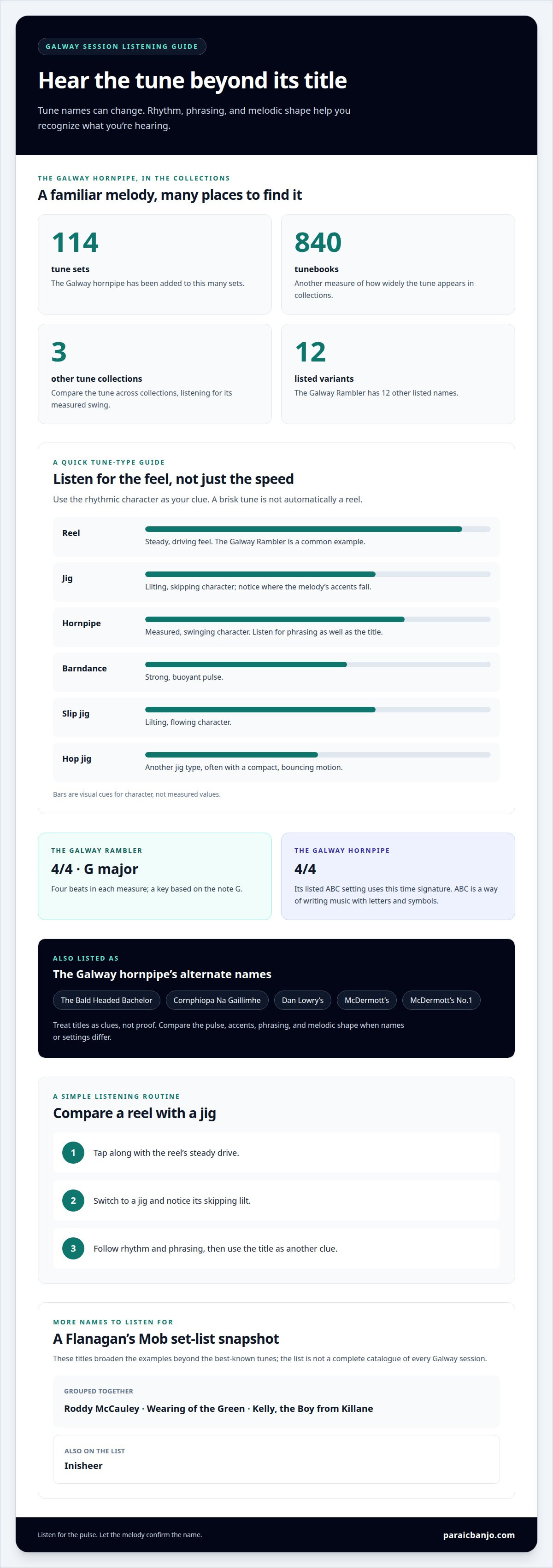
A reel is a dance tune with a steady, driving feel. The Galway Rambler is a common example, written in 4/4 time, meaning four beats in each measure, and in G major, a key based on the note G. Its name has 12 other listed variants, so titles alone may not identify it. As you explore session tunes from Galway, listen for the pulse and melodic shape to help recognize a tune.
A jig is a dance tune with a lilting, skipping character, unlike a reel’s more even drive. Listen for where the melody’s accents fall, then compare that feeling with a tune you know. Rhythm is a more useful clue than speed: a brisk performance doesn’t automatically make a tune a reel.
A hornpipe is a dance tune with a measured, swinging character. The Galway hornpipe is written in 4/4 time in its listed ABC setting, a way of writing music using letters and symbols. It’s also known as The Bald Headed Bachelor, Cornphíopa Na Gaillimhe, Dan Lowry’s, McDermott’s, and McDermott’s No.1. It has been added to 114 tune sets and 840 tunebooks. When comparing settings, listen for the swing and phrasing, not just the title.
A barndance has a strong, buoyant pulse, while a slip jig has a lilting, flowing character. A hop jig is another jig type, often with a compact, bouncing motion. Compare one example of each and listen for its lift and emphasis. Notice how each feels different rather than trying to identify tunes by speed alone.
Try a simple listening exercise with a reel and a jig. Tap along with the reel’s steady drive, then switch to the jig and notice its skipping lilt. Focus on rhythm and phrasing, whether you’re listening at home or following a session. This gives you a practical way to hear how session tunes from Galway shift in character.
Use tune titles as clues, not definitive proof. Alternate names can make a familiar melody harder to recognize on a list. When you encounter a new tune, follow its melodic shape and rhythmic feel, then compare it with a reel, jig, or hornpipe you know. With practice, session tunes from Galway become easier to recognize by sound, even when titles vary.
When checking a tune across collections, keep its melody and rhythmic character in view alongside its title. The Galway hornpipe appears in 3 other tune collections. Compare how a familiar tune is presented without treating a collection entry as proof of a different melody. Listen for its measured swing and notice whether the phrasing still feels like a hornpipe. If the name changes, return to the sound: pulse, accents, and melodic shape offer steady points of comparison. This can help you follow a tune through a session while staying open to alternate titles and settings.
Commonly played additional tunes
Additional tunes broaden a session beyond its best-known examples. A Flanagan’s Mob set list groups Roddy McCauley, Wearing of the Green, and Kelly, the Boy from Killane. It also includes Inisheer. These titles are useful starting points for exploring the wider repertoire. Treat the list as a snapshot, not a complete catalogue of every Galway session. Note each title, then listen for melodies you recognize.
Roddy McCauley, Wearing of the Green, and Kelly, the Boy from Killane appear together in the Flanagan’s Mob list. A grouped list can show how musicians organize repertoire and give you titles to look up and recognize when played. Learn one name at a time. When a tune sounds familiar, note its title and where it sits in the group. That habit makes later listening more focused.
Inisheer is another named tune in the same list, extending it beyond the three grouped titles. Keep it in a separate note until you hear how musicians place it in a set. Don’t assume every entry is played in the same order or that a printed grouping describes every session. Use each title as a listening prompt: follow the tune, then connect its sound with its name.
The Flanagan’s Mob list is useful because it gives concrete tune names, not just broad categories. Make a short listening checklist: Roddy McCauley, Wearing of the Green, Kelly, the Boy from Killane, and Inisheer. Mark each tune you recognize. If some remain unfamiliar, focus on those next. This makes a long repertoire manageable and helps distinguish knowing a tune by ear from remembering its name.
Use a repeatable routine to explore these examples: read a title, listen closely, then say the name aloud. The three grouped tunes form one cluster; Inisheer offers another point of reference. If a melody sounds familiar but its title escapes you, return to the list after listening. That pause helps connect sound and name without confusing tunes. Keep notes brief, adding details only when the music makes them clear.
These four titles are a starting point, not a ranking. The Flanagan’s Mob set list brings Roddy McCauley, Wearing of the Green, Kelly, the Boy from Killane, and Inisheer into view. Use them to broaden your session listening, then notice which tunes recur in sets. A title list guides your attention, while the musicians’ phrasing and choices reveal how the repertoire comes alive. Begin with one name, listen actively, and build from there.
Irish traditional session repertoire
Session repertoire is the collection of tunes musicians bring together to play. Flanagan’s Mob used a set list for its monthly intermediate sessions, offering a practical glimpse of how a group can organize tunes. Choose one tune from a list and listen for how musicians move between melodies. This makes it easier to follow the music without knowing every title.
Joining, requests, and recording
Joining a session means playing along while following the group’s lead. There’s no single rulebook for every gathering, so start by listening and watching how players begin and end sets.
If you play, wait for a pause before asking to join or requesting a tune. Musicians may already be building a set, and a request might not fit the moment. Ask before recording, and respect their answer. These small courtesies keep attention on the music and the people making it.
Entry and tipping customs vary by venue or event, so there’s no single rule for every Galway session. Sessions also take place beyond Galway City, with schedules set by local organizers and venues. For a session outside the city, look for recurring local listings and note the day and start time. Just as arranging regional transport through travel services like saparistation.com helps visitors navigate new regions smoothly, planning your route in advance lets you enjoy the music without worrying about the journey back.
A lively session has energetic playing and flowing sets, while an intimate one feels smaller and close-knit. Beginner-friendly gatherings make room for listeners or less experienced players, but every session has its own character. Flanagan’s Mob’s monthly intermediate sessions are one example of a group organized around a particular playing level, not a guide to every session in the county.
Tunes and instruments
Session tunes are traditional melodies played together, with instruments carrying or supporting them. Common sounds include fiddle, flute, tin whistle, accordion, concertina, banjo, and guitar. The mix varies between gatherings, and some instruments lead the tune while others provide rhythmic support.
Listen for how melody and accompaniment work together. A fiddle or flute may carry a tune while the guitar provides steady rhythmic backing. To get familiar with the sound, pick out one melodic instrument, then notice how the other players support it. This helps you follow a set, whether you’re visiting, learning, or simply enjoying the session.
The list offers concrete combinations to listen for: Sweeney’s Polka, Murphy’s Polka, and Hannah’s Polka; West Clare Jig with Dingle Regatta; The Silver Spear with Shannon Breeze; and Buachaill on Eirne with South Wind. These pairings help you follow tune titles as a set moves between melodies. Flanagan’s Mob’s examples give listeners specific names to recognize without needing to know the whole repertoire.
A comment identifies The Galway Rambler as also known as Lord Wellington, citing item 199 in Breathnach’s first volume. One suggested variation replaces C with E in the 2nd and 6th bars and uses F-sharp at the end of each part. This detail provides another point of recognition when comparing versions of familiar tunes.
What traditional tunes are commonly played at Irish sessions in Galway?
A session tune’s setting is one version of its melody. The Galway gives a useful example of how players and recordings carry tunes into wider circulation. The Kilkenny’s played it in a set on their 2014 album The Colour of Freedom. Treat the recording as a listening starting point, not a fixed template. Follow the melody and notice how it sits beside the other tunes in the set.
Instrument range can shape a tune’s setting. In 2006, a contributor asked Peter Horan about the low C-sharp in The Galway, a low musical note that some flutes may not reach. The discussion noted that a flute player could play those notes an octave higher, meaning in the next higher range of the same notes. The contributor said this worked alongside someone playing the low note, and sounded reasonable solo. Listen for how the higher range changes the tune’s color.
Older recordings can preserve melodic details that later players handle differently. A commenter recalled a particular version of the measure “gabg gabg”, a short sequence of notes, in recordings from before the 1960s. Compare the phrase across recordings and notice whether its shape or emphasis changes. A setting can shift while the melody remains recognizable.
Players may also encounter versions with different numbers of parts. A commenter recalled Tommy Keane playing a three-part version at a Willie Clancy Week recital, and possibly recording it on an LP in the 1970s. As you listen, follow where each part begins and ends. If a version seems longer than expected, listen for an additional section before deciding the melody is unfamiliar.
Learning histories can connect a tune with different places and generations. Mick Mulcahy recalled learning a version of The Galway Rambler in London in the 1960s, according to the sleeve notes for The Reel Note. Louise Mulcahy taught a setting of the tune at a music camp in August 2023. These references show how settings travel through teaching and playing. Compare versions by noting changes in melody, phrasing, octave, and number of parts.
For a practical listening exercise, choose one tune and track these changes as you listen. The Galway’s low C-sharp offers an example of how instrument range can shape a performance, while Tommy Keane’s recalled three-part version gives you another detail to listen for. Use these clues to recognize variations while keeping the tune in mind.
Are Galway music sessions open to beginners and visitors?
A traditional session is a gathering where musicians play Irish tunes together. Beginners and visitors can start by listening, then decide whether joining suits the players’ pace. Session formats differ, so take your cue from the musicians rather than assuming every gathering works the same way.
A beginner is a player still building a reliable tune repertoire and confidence. Flanagan’s Mob’s monthly intermediate sessions used a set list, giving players a practical way to prepare. “Intermediate” indicates a particular playing level, so it may not suit someone just starting out. Use the listed tunes to understand what that session expects, then choose a comfortable way to participate.
A visitor attends a session without being part of its regular group. Start by listening, watching how tunes begin, and noticing whether musicians take turns. If you play, wait for a pause before asking whether there’s room to join. Keep your instrument ready, but don’t launch into a tune over an existing set. Patience helps you fit the music’s flow.
Preparation can make a first visit feel less daunting. Choose a few named tunes from the repertoire, such as Sweeney’s Polka or The Galway Rambler, and learn their melodies before playing along. Recognizing a tune is useful, but knowing its form helps you follow the group. If you’re unsure, listen through a complete set before deciding whether to take part.
Session etiquette means showing consideration for the musicians and the music. Keep conversations low while a tune is underway, and avoid interrupting a set with requests. Ask before recording, since a session is also a shared social space. If the players decline, put your device away and enjoy the music directly. These simple choices show respect for the gathering.
Sessions vary in pace and playing level. Flanagan’s Mob’s monthly intermediate format is one example, but its set list isn’t a guide to every Galway gathering. For a beginner, listening can be a complete and worthwhile way to take part. A more confident player can follow the group’s cues and join when the moment feels right.
Try this simple approach: arrive ready to listen, identify a tune you know, and watch how the musicians share the playing. Then decide whether to join, ask a brief question during a pause, or simply stay with the music. Each session gets its character from its players and their choices, so curiosity and respectful attention are good companions for a first visit.
Páraic Banjo
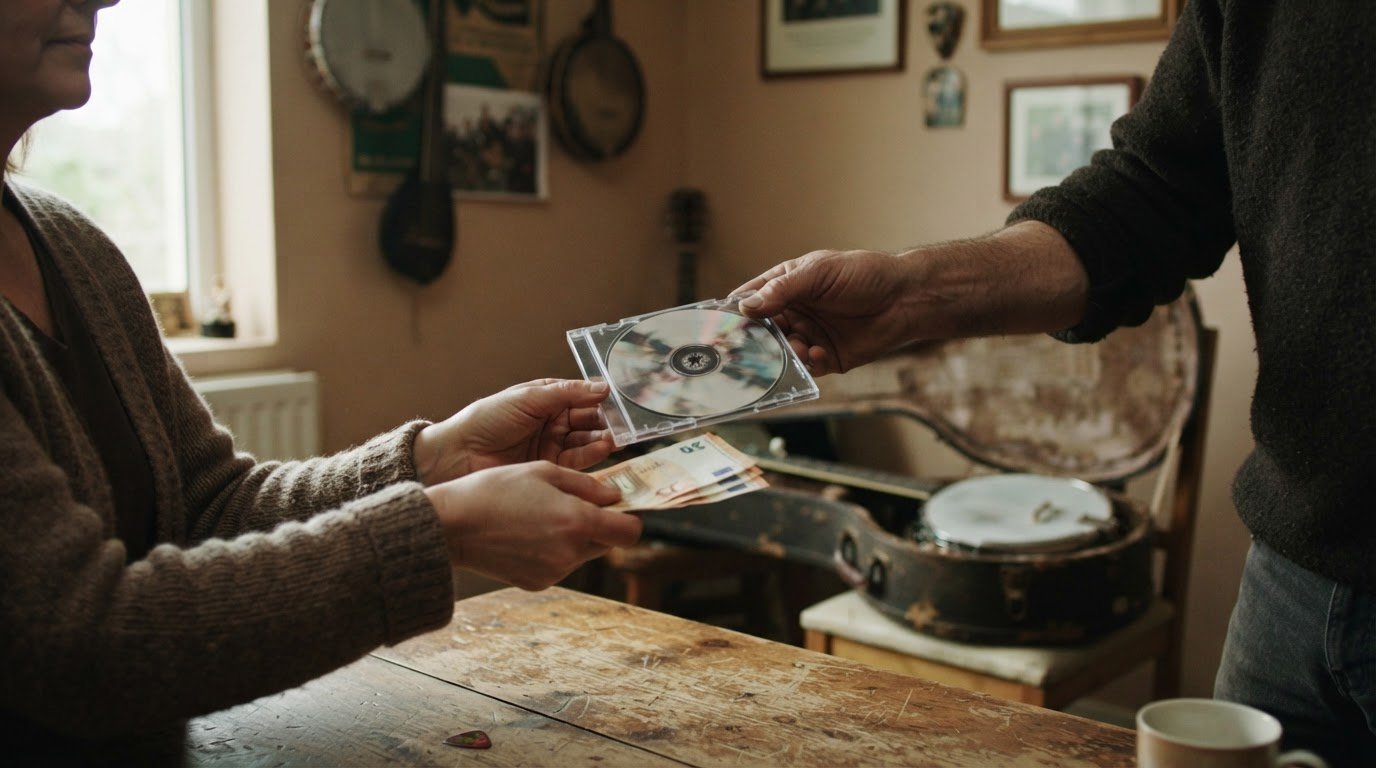
Páraic Banjo offers a way to keep exploring Irish session music through recorded tunes. Not Before Time - 39 Years in the Making brings together 18 tracks recorded live with expert musicians, capturing the sound and shared energy of traditional playing. Choose the digital album or physical CD to hear the collection, or explore individual digital tracks. Listening closely can help you follow how melodies move, how instruments weave together, and how a set gathers momentum. It’s a natural next step after discovering Galway tune names and pairings, whether you’re building your repertoire or simply enjoying the music. For more about the recordings, contact Páraic Banjo.
Keep the Music Moving
Make your next step active listening. Choose a melody that caught your ear, then follow how its phrasing changes between players. A small tune notebook can help: write down the name, tune type, and a detail you noticed. Over time, your notes will make session tunes from Galway easier to recognize and remember, whether you’re listening closely or joining in.
For a recorded taste of traditional session playing, listen to Páraic Banjo’s music beyond this guide. Return to a tune with fresh ears, notice how the instruments work together, and let curiosity lead you to another melody. The repertoire is best explored one tune at a time.
Contact Páraic Banjo to continue exploring the music. Keep listening, keep learning, and enjoy the next tune.
Comments