Traditional Irish Banjo Album: Its Tunes, Tracks and Reception

A traditional Irish banjo album comes alive through the pulse of the playing and the company around it. This one brings together 18 tracks, recorded live with expert musicians, in the spirit of traditional Irish session music. Listen for the way the rhythm carries each tune.
If you’re drawn to Irish banjo, you’ll want more than a title list: you want to know what the music feels like, which tunes shape the set, and how listeners have received it. This guide explores those details, including the track list and tune types, while showing what to notice in the banjo’s rhythm and interplay with other musicians.
Choose one detail to listen for first, perhaps a change of tune or the banjo’s rhythmic lift. Then see what else you notice.
Table of Contents
Album description and reception
A traditional Irish banjo album can draw on inherited tunes, new songs, or both. They’re Calling Me Home brings original songs together with traditional songs, creating a useful example of that balance. Its repertoire lets listeners hear how familiar material and newer writing can sit side by side. Rather than treating tradition as a fixed list, the album makes room for fresh composition within an established musical world.
The recording setting adds another part of its story. They’re Calling Me Home was recorded in a studio outside Dublin during the pandemic. That detail places the album in a particular moment, while the studio setting gives the songs a shaped, recorded presentation rather than the feel of an unedited session capture. When listening, notice how the arrangements support each song and how the performance moves between traditional material and original writing.
Reception is more useful to consider through specific listening choices than a vague label such as “authentic.” Start with one traditional song, then compare it with an original from the same album. Listen for changes in melody, phrasing and accompaniment. This simple comparison shows what the musicians preserve and where they make their own choices. It also gives newcomers a clear way into the repertoire, without needing to know every tune’s history first.
The instrument itself helps explain the sound. An Irish tenor banjo has four strings and developed from the five-string banjo. Its GDAE tuning matches an Irish fiddle, making it possible to follow familiar melodic shapes across both instruments. That shared tuning doesn’t make their tones identical. Instead, it offers a practical point of comparison: notice how the banjo’s crisp attack marks the beat, then hear how a fiddle might carry the same tune with a sustained sound.
Separate the album’s details from your own response. The repertoire, recording approach and musicians are facts; words such as “warm,” “driving” or “intimate” describe what you hear. Try one listen for the tunes, another for the ensemble and arrangement, then focus on the tenor banjo. This turns a general impression into a clear account of what works for you, and why.
Albums that combine original and traditional songs also invite different expectations. A listener seeking familiar tunes may value recognisable melodies; someone drawn to songwriting may focus on how new material sits within the tradition. They’re Calling Me Home offers both entry points through its mix. Keep those preferences in mind when comparing recordings, and describe the specific song or musical choice behind your reaction rather than treating one taste as the measure of the whole tradition.
Album features and track details
Track details reveal more than tune names. Instrument credits can show whether a recording gives the banjo room to lead or places it inside an ensemble. Two examples offer contrasting listening experiences: The Cat That Ate the Candle pairs Irish tenor banjo with piano, while “Introducing The Pecker” features Pecker Dunne playing plectrum-style zither banjo. Listen for how those combinations shape each performance.
On Not Before Time, compare a solo passage with an ensemble section. First, follow the banjo’s melody. Then listen again for how the other musicians support or answer it. This focused approach helps you hear how the instruments share the performance, rather than treating accompaniment as background.
The album’s combination of solo and ensemble tunes offers different ways to hear the tenor banjo. In a solo passage, notice the player’s timing and melodic choices; in an ensemble tune, listen for how the banjo fits with the other instruments. These comparisons help show the range of playing styles within traditional Irish music.
Are there traditional Irish banjo albums focused on solo playing? Yes. Solo passages put one player’s phrasing, timing and melodic choices at the centre. Compare one with an ensemble tune to hear what changes when other instruments join.
Which Irish traditional music albums feature banjo alongside fiddle and flute? The examples discussed here pair banjo with piano or melodeon, rather than documenting a fiddle-and-flute lineup. To assess an album’s instrumentation, read its track credits and listen for each instrument’s tone, especially when several melodic parts play together.
A useful listening exercise is to compare an instrumental pairing with a solo passage. Choose a short section, identify the banjo line, then replay it while focusing on the accompanying instrument. Ask whether the second part doubles the melody, answers it, or supports the rhythm. With The Cat That Ate the Candle, focus on piano and banjo; with “Introducing The Pecker,” attend to Dunne’s plectrum-style zither banjo playing. Those focused listens make track details meaningful, not just names on a list.
Not Before Time features solo and ensemble tunes, with ten additional Irish musicians playing a variety of traditional instruments.
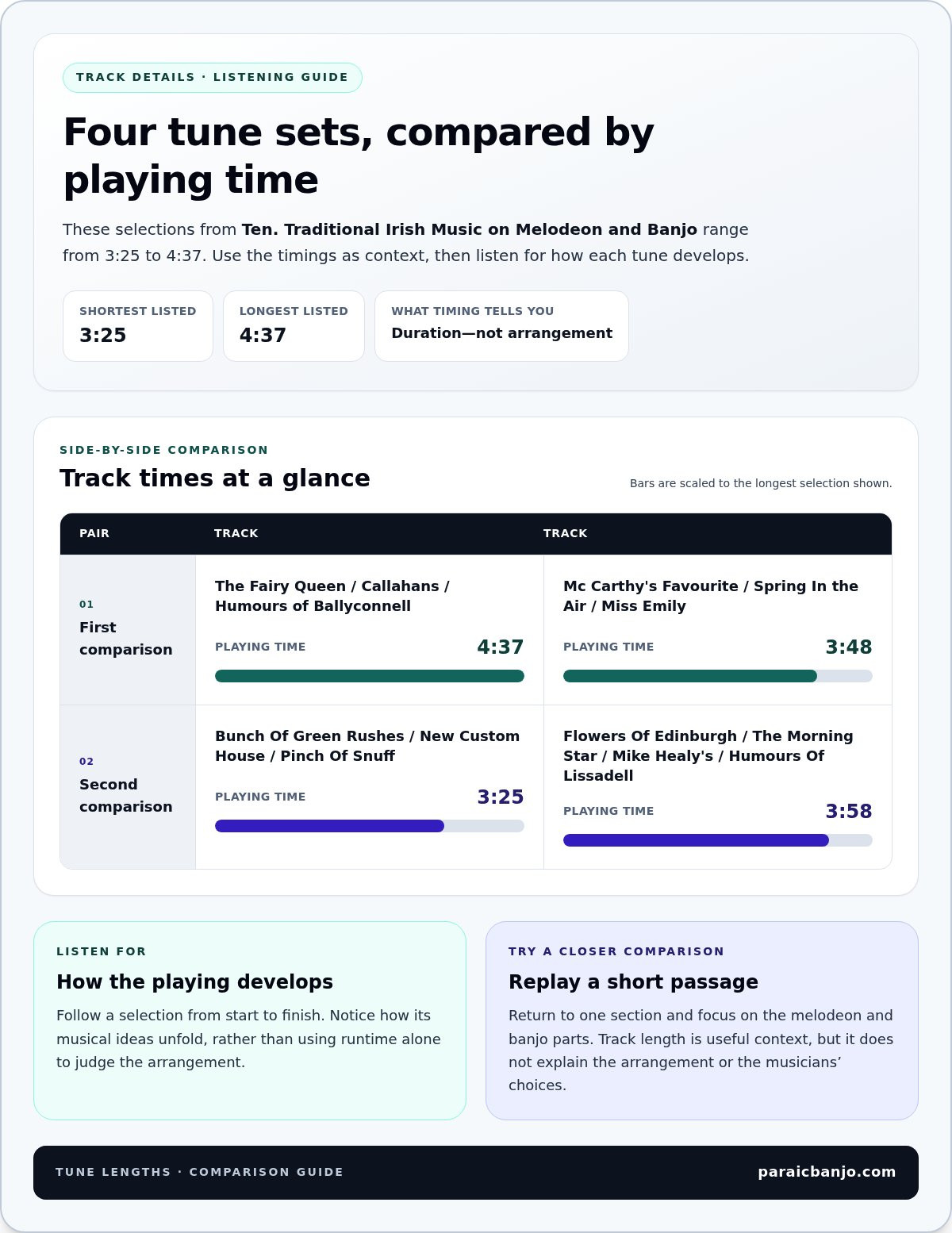
Track lengths add a practical dimension to comparing the selections on Ten. Traditional Irish Music on Melodeon and Banjo. The track “The Fairy Queen / Callahans / Humours of Ballyconnell” runs 4:37, while “Mc Carthy's Favourite / Spring In the Air / Miss Emily” runs 3:48. These timings help listeners set the selections alongside one another and decide whether to focus on a brief passage or follow a tune through its full recording.
The track “Bunch Of Green Rushes / New Custom House / Pinch Of Snuff” runs 3:25, and “Flowers Of Edinburgh / The Morning Star / Mike Healy's / Humours Of Lissadell” runs 3:58. Listening with the durations in mind can make it easier to plan a close comparison: note how the playing develops, then revisit a passage to attend to the melodeon and banjo parts. Track length is useful context, though it does not by itself explain the arrangement or the musicians’ choices.
Track listing and tune types
A tune title is a useful clue, but it doesn’t always name the dance form. A track listing may identify one melody, group several together or use a local title unfamiliar to new listeners. Treat each title as a starting point, then listen to the music to decide what rhythmic feel you hear.
For a jig, listen for its lilting motion and rolling beat. A reel usually feels more even and forward-driving, while a hornpipe often has a more deliberate swing. These descriptions help you compare styles, but phrasing can soften or sharpen each feel. Listen for accents and the spaces between notes, not just the overall speed.
Try this with any recording: first tap the pulse without naming the tune type. Next, notice where the melody places its strongest accents. Finally, compare your impression with the track information. This keeps a title from shaping your judgment before you hear the playing and helps beginners recognise rhythmic differences without reading notation.
Track listings can help you plan a focused listen. Pick a title you recognise, then compare it with an unfamiliar one on the same album. Ask whether the unfamiliar tune has a similar rhythmic feel or a contrasting one. If a listing groups tune names together, listen for changes in melody and character rather than assuming every section is the same type.
Keep a simple listening note for each track. Write down the title, the feel you hear and one moment that stands out. For example, note whether the melody sounds lilting, straight or gently swung, then mark where that quality is clearest. This creates a personal guide to the repertoire and makes it easier to revisit tracks with a sharper ear.
Jig: Listen for a lilting, rolling feel.
Reel: Notice the steady, driving movement.
Hornpipe: Listen for a more measured swing.
Don’t worry about assigning a perfect label on the first listen. Focus on what the rhythm invites you to do: sway, tap steadily or lean into a stronger swing. A track listing supplies names; your ears reveal the musical character. Compare that character across recordings to notice how different players bring their own lift and shape to traditional tunes.
Where can I stream or buy traditional Irish banjo albums?
Decide how you want to listen: a digital album, individual digital tracks or a physical CD. A digital album gives you the full sequence, while individual tracks let you focus on particular tunes. A CD offers a physical copy. Knowing what suits your listening habits makes it easier to choose.
For streaming, search inside the music service you already use. Enter the artist’s name and the exact album title, then compare the track names with the album information. This helps distinguish the intended recording from similarly titled releases or playlists. For example, check that the opening track and album artwork match before adding it to your library.
Streaming can be useful for sampling a full record before choosing a favourite. Play the opening track, then move to a tune set with several titles. Notice whether the album keeps a consistent ensemble sound or shifts between different arrangements. Save tracks that stand out, and return to the full sequence later. That way, you can hear how each tune sits within the album.
For a digital purchase, look for the artist’s official album page or store. Confirm whether the item is a complete album or an individual track before completing your order. A full album suits listeners who want the sequence as arranged; buying one track can work when a particular tune is the main draw. Keep the album title and artist name together while searching to avoid selecting a different recording.
Physical CDs are another route for listeners who prefer a tangible collection. Read the product description for the album title, artist, and track listing. If the track names are grouped with slashes, they may indicate multiple tunes performed within one track. Matching those names against the listing helps you identify the recording and understand what the disc contains.
Use these steps to choose confidently:
Pick streaming, a digital album, or a CD before searching.
Match the artist name, album title, artwork, and track listing.
For a digital purchase, distinguish the complete album from an individual track.
For a CD, check that the listed tunes match the recording you want.
Choose the format that suits the way you listen: the physical CD, digital album or individual digital tracks. Search for Páraic Banjo and the exact title, Not Before Time, to find the intended recording. Then decide whether you want to explore particular tunes or hear the album unfold from beginning to end.
What should I listen for when comparing Irish banjo albums?
Start with the melody, then notice what the banjo adds around it. In one recording, the instrument may carry the tune; in another, it may drive the rhythm beneath a fiddle or flute. Choose the same tune across two albums when possible. Compare how each player shapes its phrases, accents and ending. That gives you a clearer basis than judging by speed alone.
Next, listen for pulse. A reel can feel brisk and propulsive, while a jig often has a lilting beat. Tap along and notice whether the rhythm stays buoyant through tune changes. An energetic performance doesn’t have to feel rushed. Listen for clear notes and a steady beat, especially where the melody turns or the next tune begins.
Pay attention to the banjo’s place in the ensemble. With a fiddle, listen for whether both instruments follow the same melody or take distinct parts. With flute, notice how the banjo’s crisp attack contrasts with the flute’s sustained notes. In a solo passage, focus on the player’s timing and phrasing without accompaniment. These comparisons help explain why two albums built around traditional tunes can sound quite different.
Arrangement matters, too. A track may present one tune alone or link several into a set. Follow the transitions: does the next melody arrive smoothly, or does the change create a fresh burst of energy? Notice whether accompaniment supports the tune or competes for attention. Try listening once for the banjo, then again for the other instruments. You’ll catch details that can disappear when everything blends together.
Recording balance shapes what you hear. Ask yourself whether the banjo is clear beside the other instruments and whether you can follow the melody throughout. A prominent banjo isn’t automatically better; the right balance depends on whether you want to study the playing or enjoy the ensemble. Compare the opening with a later section, since an arrangement can change as a performance unfolds.
Use a short listening checklist as you compare:
Choose one tune or tune type shared across recordings.
Compare pulse, phrasing and transitions between melodies.
Listen for the banjo’s role beside fiddle, flute or other accompaniment.
Decide whether the arrangement and recorded balance suit your listening preference.
For a practical test, take one album from beginning to end, then revisit a favourite track. Note the tune, the ensemble and the moment that caught your attention. Listen closely to an Irish banjo album and put these comparison points to work. A few focused passes can turn a first impression into a thoughtful account of the playing.
Páraic Banjo: Not Before Time - 39 Years in the Making (Physical CD)
Not Before Time - 39 Years in the Making is Páraic Banjo’s natural next listen if you want traditional Irish session music shaped by lively ensemble playing. The album brings together 18 tracks, recorded live with expert musicians, offering a full set of tunes to explore.
Choose the physical CD if you prefer a tangible album, the digital album if you want the complete sequence in digital form, or individual digital tracks to focus on particular tunes. Each option lets you approach the music in a way that suits your listening habits. Start with the full track sequence, then return to the tunes that stay with you.
Visit paraicbanjo.com to explore the album and choose how you’d like to hear it.
Let the Next Tune Lead You
Choosing a traditional Irish banjo album can be the start of a deeper listening habit. Pick a tune that stays with you, then return to it with fresh ears. Notice a new phrase, a change in rhythm or the way the ensemble leaves space for the melody. That small moment of attention can open a path into the wider tradition.
If you’d like to keep that exploration close, Páraic Banjo offers Not Before Time - 39 Years in the Making as a physical CD or digital album, along with individual digital tracks. Choose the format that suits how you like to listen, whether you prefer a complete album or a particular tune. Visit Páraic Banjo to explore the music and get in touch. Keep listening, and let the next tune lead you somewhere new.
Frequently Asked Questions
What are the best traditional Irish banjo albums?
There’s no single best choice for every listener, but Not Before Time - 39 Years in the Making is a strong pick for traditional Irish session music. Irish Echo reviewer Daniel Neely called it “A absolute must-have for anyone who loves traditional Irish music,” while musician Derek Hickey praised its “Perfect pace, perfect space, rock solid music.” Use those responses as a starting point, then decide whether the album’s sound and repertoire suit your own taste.
Comments