Traditional Irish Banjo Albums for Classic and Modern Tunes

Traditional Irish banjo albums span lively dance-tune sessions and recordings that take the music in fresh directions. For a place to start, try Humdinger, the first full recording of banjo and melodeon music, and They’re Calling Me Home, released in 2021 by Rhiannon Giddens and Francesco Turrisi. Together, they show how different an Irish-rooted sound can feel from one album to another.
If you love the lift of a reel or jig, the tune is only part of the story. Tempo, phrasing, accompaniment and the way tunes are paired all shape the feel. This guide explores traditional and contemporary recordings, with practical pointers for hearing how familiar melodies are arranged. You’ll discover which albums capture the pulse of a session, which broaden the palette, and what to listen for as the banjo moves through a set. Settle in and follow the tunes.
Table of Contents
1. Traditional and contemporary banjo recordings
Traditional Irish banjo albums range from dance-driven sessions to collaborative recordings with broader musical textures. Humdinger is described as the first full recording of banjo and melodeon music, pairing the bright, clipped banjo sound with the melodeon’s sustained melody. For a contemporary contrast, Rhiannon Giddens and Francesco Turrisi released They’re Calling Me Home in 2021. They recorded it in a studio outside Dublin during the pandemic, with Emer Mayock adding flute, whistle, and pipes to some tracks. Listen for how those instruments change the color and pace around the tunes.
For a live Irish banjo recording, start with Páraic Mac Donnchadha’s Not Before Time - 39 Years in the Making. Its 18 tracks were recorded live with expert musicians, letting you hear the banjo within an ensemble rather than as an isolated instrument. The digital album is available to download. As you listen, compare the banjo’s rhythmic drive with the other players’ parts, then notice how the group shapes each tune’s momentum. That makes it a useful choice if you want the feel of musicians playing together.
Traditional Irish banjo albums stand apart from mandolin or fiddle recordings through the banjo’s sound and role in the arrangement. Its crisp attack can bring each note into focus in a fast reel, while a fiddle carries a bowed line and a mandolin shares a plucked-string sound. These are listening cues, not fixed rules: the tune, tempo and accompanying musicians all affect the result. Compare a banjo-and-melodeon recording such as Humdinger with the flute, whistle and pipes heard on some tracks of They’re Calling Me Home. Listen for attack, sustain and rhythmic feel.
For solo Irish tenor banjo, distinguish a solo-led performance from an album featuring banjo alongside other players. The recordings named here are collaborative or ensemble-based: Humdinger features banjo and melodeon, while Not Before Time was recorded live with musicians. If you’re choosing an album to hear the banjo’s part clearly, listen for passages where accompaniment falls back and the melody comes forward. For digital access, Not Before Time - 39 Years in the Making is available as a digital album download. Begin with one track, then replay it while following the banjo’s phrasing and the ensemble’s response.
2. Traditional tunes and arrangements
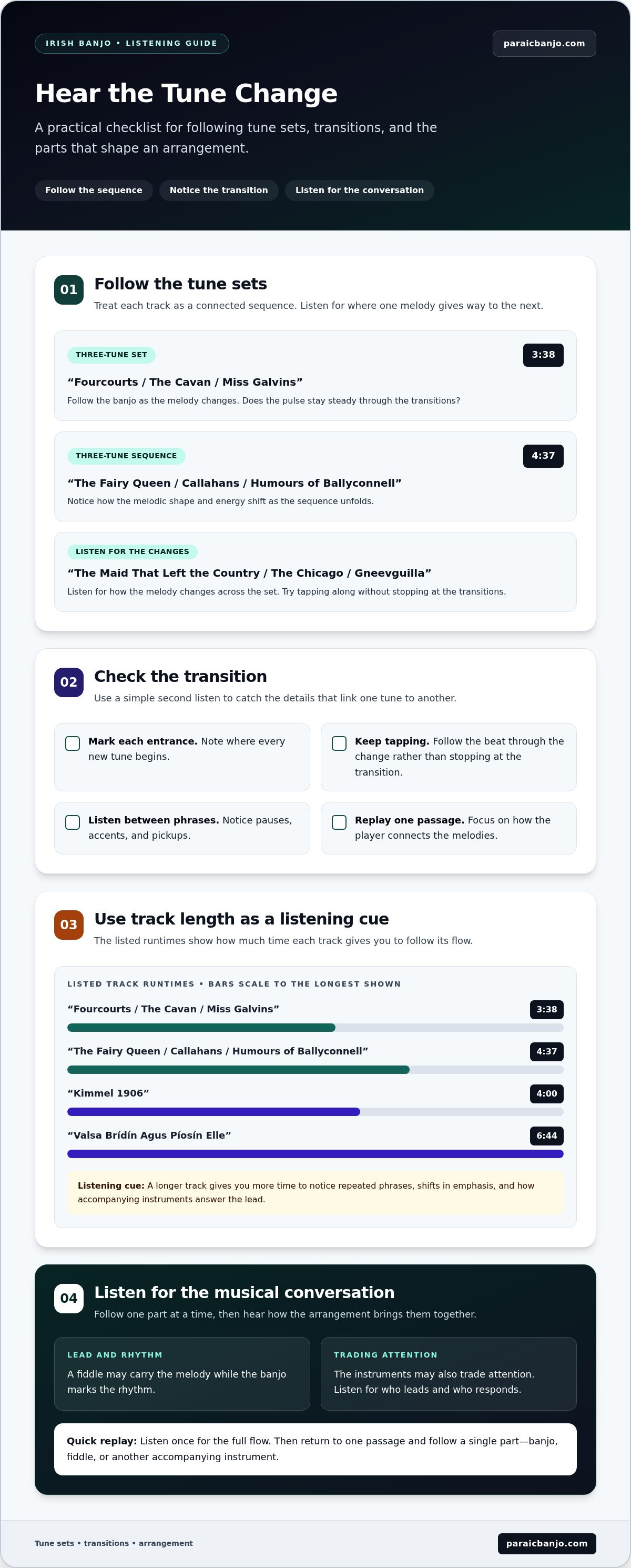
Listen for how an album groups melodies into sets, rather than treating every tune as a separate performance. “Fourcourts / The Cavan / Miss Galvins” runs for 3 minutes 38 seconds, joining three named tunes in one track. That format creates a useful listening challenge: follow the banjo as the melody changes, and notice whether the pulse stays steady through each transition. Then replay the set and focus on the spaces between phrases. Those small pauses, accents, and pickups help reveal how a player connects one tune to the next.
Another example, “The Fairy Queen / Callahans / Humours of Ballyconnell,” lasts 4 minutes 37 seconds. The three-part title signals a sequence, so listen for changes in melodic shape and energy as the set unfolds. “The Maid That Left the Country / The Chicago / Gneevguilla” invites you to listen for how the melody changes across the set. Try noting where each tune begins, then tap along without stopping at the transitions. This makes arrangement choices easier to hear than listening for the banjo alone.
Track length can also change the listening experience. “Kimmel 1906” lasts 4 minutes, while “Valsa Brídín Agus Píosín Elle” extends to 6 minutes 44 seconds. A longer track gives you more time to notice repeated phrases, shifts in emphasis, and how accompanying instruments answer the lead. Listen once for the full flow, then return to one passage and follow a single part. A fiddle, for example, may carry a melody while the banjo marks its rhythm, or the instruments may trade attention. The arrangement determines the conversation.
Keep the word “American” in perspective when comparing recordings: a shared label such as banjo doesn’t make every tradition or arrangement the same. Instead, compare what you can hear: the tune sequence, the strength of the pulse, the space around the melody, and how the fiddle or other instruments respond. For a simple listening exercise, choose one set, write down each tune title, and mark the transition that stands out most. Then explore Irish banjo tune arrangements with those listening cues in mind.
3. Which albums feature Irish tenor banjo music?
Not Before Time - 39 Years in the Making is a useful choice if you want to hear Irish tenor banjo in both solo and ensemble tunes. That contrast lets you focus first on the banjo’s melody, then hear how it works alongside other musicians. Start with a solo passage and follow the tune’s shape. On another listen, notice how the ensemble supports the melody and keeps the music moving.
Album descriptions and liner notes help you identify recordings that feature Irish tenor banjo. Look for the instrument named directly, then check whether the banjo player appears throughout the album or on selected tracks. The distinction matters: a recording may include banjo without making it the central sound. For a practical shortlist, note the album title, credited player and any track details about solo or ensemble performances.
Next, listen for the banjo’s role rather than relying on genre labels. Does it carry the tune, reinforce the rhythm or move between the two? Try this with a track from Not Before Time: follow the banjo line through a full phrase, then listen again to how the other musicians respond. You’ll get a clearer sense of the arrangement and whether you prefer an exposed melody or a fuller group sound.
Keep instrument type and musical tradition separate in your notes. “Banjo” alone doesn’t tell you what style of playing or ensemble an album features. Compare the credits with what you hear: a clear instrument credit is useful, while listening lets you judge the banjo’s prominence. If the track list distinguishes solo and group pieces, use it to choose a starting point that suits your listening goal.
For a focused comparison, choose one solo tune and one ensemble tune from the same album. Listen once for the melody, then again for the banjo’s contribution to the pulse and phrasing. Note one difference, such as how clearly the tune stands out or how the group shapes its momentum. This makes it easier to choose Irish tenor banjo recordings by sound and arrangement, rather than by title or broad genre alone.
A player’s background can add another point of interest when exploring recordings. Enda Scahill began playing music at six years old. Keep that detail distinct from what an album’s credits or sound tell you: it gives background about the musician, while listening helps you assess the banjo’s role in a particular performance. You can note both when comparing recordings, without assuming a player’s history determines the sound of a track.
If you are also considering an instrument, the banjo store offers Irish tenor banjos with 17 frets and 19 frets. Treat those as available options rather than as evidence about which albums feature the instrument. For listening, return to the credits and track details, then use the recording to judge how clearly the banjo carries the melody or fits into the ensemble. Keeping performer background, instrument specifications, and the sound of the recording in separate notes can make your comparisons more precise and help you decide what to hear next.
4. Which Irish traditional musicians are known for banjo albums?
Enda Scahill is a central name to look for when exploring Irish banjo recordings. To make a musician’s work easier to recognize, begin with the artist credit, then compare the banjo’s role across the tracks. Does the player carry the melody, anchor the rhythm, or share both jobs? Write down one detail from each listen. You’ll build a clearer picture of an artist’s musical character without relying only on a short biography.
Album credits also show how Irish traditional music grows through collaboration. Rhiannon Giddens and Francesco Turrisi are useful names to recognize in contemporary recordings, while Emer Mayock’s contributions offer another way to follow a musician’s sound. Rather than treating a record as the work of one performer, note who plays and what each part adds. A flute, whistle or set of pipes can change the texture around a melody, making the arrangement feel more spacious or tightly woven.
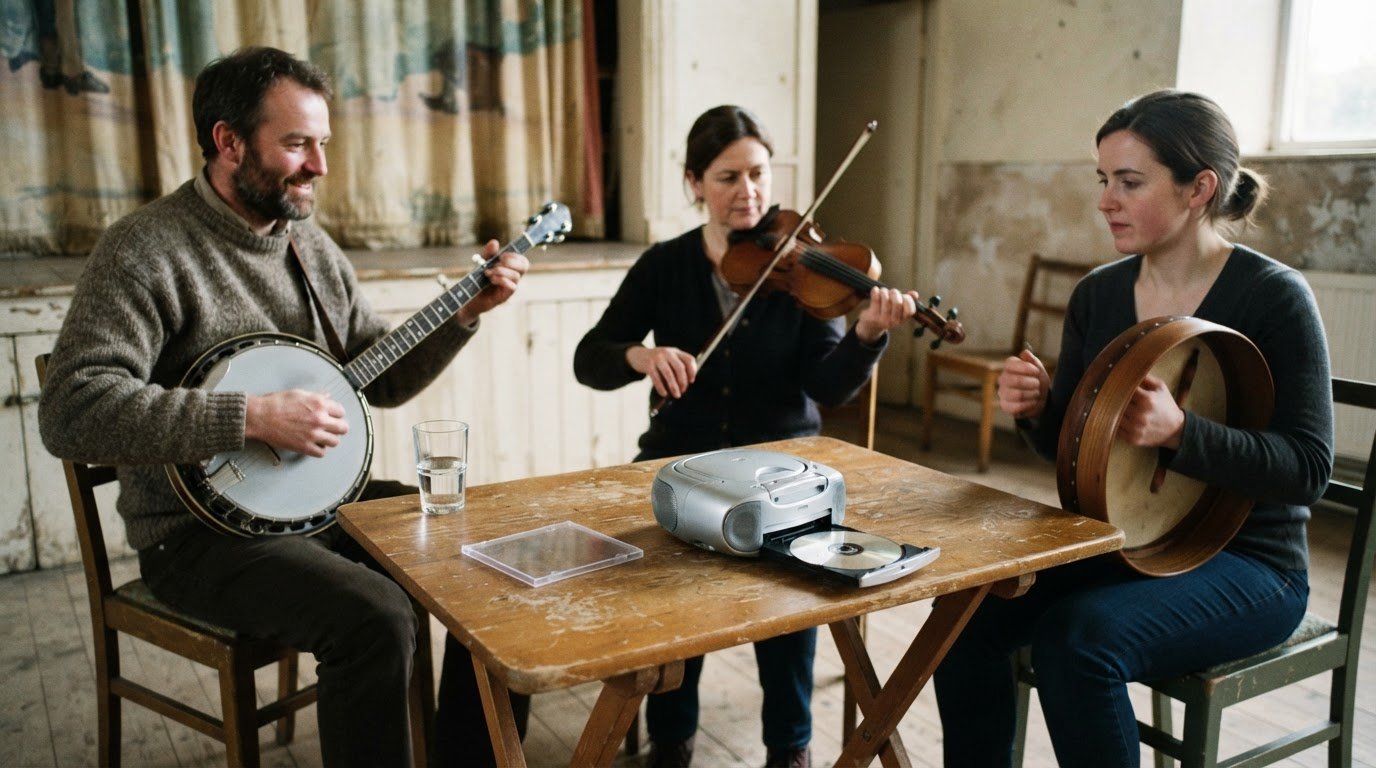
For a musician-focused listening session, choose a track with clear credits and follow one player at a time. Start with the named banjo performer, then listen again for the other instruments’ responses. If the track features a fiddle or pipes, notice whether it echoes the melody or introduces a contrasting phrase. This approach helps you distinguish an individual contribution from the full group sound, and compare recordings without specialist knowledge.
Keep a short listening log as you explore. Note the musician’s name, the instrument you followed and one detail about phrasing or rhythm. If a recording lists several contributors, track how the arrangement changes when another instrument takes the lead. Names such as Scahill, Giddens, Turrisi and Mayock can become useful landmarks, prompting you to notice different parts of the musical conversation.
Musician credits are a starting point, not a substitute for listening. A performer’s role can vary from one setting to another, and the arrangement affects how prominently the banjo comes through. Choose a track, read its credits, then listen once for the melody and again for the accompanying parts. This simple comparison helps you discover which performers and ensemble sounds to follow, while keeping the focus on the music.
Enda Scahill is a four-time All Ireland Champion banjo player from Corofin, County Galway. He has played and taught Irish banjo for over 30 years. Those details make him a useful anchor when comparing banjo recordings: listen for how his playing shapes a tune, then consider what the surrounding instruments contribute.
An album is more than a showcase for virtuosity. Follow the banjo through a passage, noting when it holds the melody steady and when it leaves room for another voice. Return to the same passage and focus on the ensemble, considering how the arrangement changes your sense of the tune. This close listening offers a practical way to appreciate Scahill’s work and decide which recordings deserve another listen, without assuming reputation alone explains an album’s character.
5. What are the best beginner-friendly Irish banjo albums?
The best first album is one you’ll want to hear again, not necessarily the one with the simplest playing. Start with the opening track and one from later in the track list. Notice whether the tunes hold your attention and whether you can follow the main melody. If the sound draws you in, return for a closer listen. Enjoyment is a useful guide: repeated listening reveals details that might pass by the first time.
Use the track list to choose a manageable starting point. A title naming a tune or set makes it easier to find a passage again, while a clearly described solo performance can make the lead part easier to follow. Pick one track rather than trying to absorb a whole album at once. Listen without multitasking, then replay it with your attention on the melody. This simple routine makes unfamiliar tunes more approachable.
Beginners can compare how an album balances solo passages and ensemble playing. A solo-led section lets you follow one musical line; group passages reveal how the instruments fit together. You don’t need to identify every instrument. Notice when the sound grows fuller, when the melody becomes easier to hear, and which moments make you want to replay the track. Note those moments to guide your next choice.
Before choosing, read the album description and track titles, then listen to a sample if available. Look for details that match your listening goal: a strong banjo focus, a mix of solo and group performances, or tunes you can return to by name. Don’t judge a recording by speed alone. A measured passage can reveal phrasing and tone, while a livelier set makes the rhythmic lift more obvious.
Build your own starter playlist from the tracks that held your attention. Give each selection another listen on a different day, and write down one sound or musical moment you noticed. This keeps exploration relaxed and personal, with no need to master the full tradition at once. If you’re ready to continue listening, explore Irish banjo recordings and choose a tune that draws you in.
Páraic Banjo: Not Before Time - 39 Years in the Making (Physical CD)
Páraic Banjo’s Not Before Time - 39 Years in the Making is a natural next listen after exploring traditional and contemporary Irish banjo recordings. This debut album brings together 18 tracks recorded live with expert musicians, capturing the feel of traditional Irish session music. Choose the physical CD if you’d like a tangible album to enjoy from start to finish. The same recording is also available as a digital album, with individual digital tracks for listeners who prefer to choose specific tunes. The title nods to a long journey reaching its moment, while the ensemble playing keeps the music rooted in shared tradition. Explore the album, then visit paraicbanjo.com to hear more.
Keep Following the Tune
Let curiosity guide your next listen. Choose a recording that catches your ear, then return to one passage with a fresh focus: the banjo’s rhythm, the melody’s shape or the way the other musicians respond. This habit can turn a favorite track into a deeper appreciation of the playing and the tradition behind it.
Building a personal collection of traditional Irish banjo albums doesn’t have to mean chasing a definitive list. Follow the musicians and sounds you enjoy, and let each recording point you toward another style or arrangement. If you’d like to continue exploring Páraic Mac Donnchadha’s music, visit Páraic Banjo and choose the listening format that suits you.
Keep your ears open, take the tunes at your own pace and enjoy the journey. There’s always another melody waiting to be heard.
Frequently Asked Questions
What are the best traditional Irish banjo albums?
A varied starting shortlist includes Humdinger, Not Before Time - 39 Years in the Making, and BEO. These recordings offer distinct settings: banjo with melodeon, Páraic Mac Donnchadha’s debut album, and a live group performance with Padraig Keane on pipes, Macdara Ó Faoláin on bouzouki, and Jimmy Higgins on bodhrán. Choose by the ensemble sound you enjoy, then compare how the banjo sits within each arrangement.
What are essential classic Irish banjo recordings?
For a foundational listen, start with Humdinger and add Not Before Time - 39 Years in the Making for a different perspective. The latter’s accompanying 36-page booklet offers liner notes and context about the musical traditions of East Galway and Clare. Read a passage before listening, then notice how that regional background shapes your attention to the tunes and their performance.
What are recent traditional Irish banjo album releases?
Not Before Time - 39 Years in the Making is a contemporary release, issued in 2021. Its 70 minutes bring together reels and both solo and ensemble tunes, with ten additional Irish musicians featured. The album is available as a physical CD and digital album, with individual digital tracks also offered. For a focused listen, choose one track and follow how the banjo’s part works within the tune.
Comments