Traditional Irish Banjo Albums for Singing and Reworked Songs

Traditional Irish banjo albums differ in how they balance instrumental tunes, vocals, and fresh arrangements of familiar songs. Some focus on the drive of session playing; others make room for singing or give well-known material a new turn. The right choice depends on what you want to hear.
A lively tenor banjo can carry a melody with lift and energy, while vocals bring another kind of warmth and a new arrangement can make an old song feel newly discovered. Knowing what an album offers helps you find the sound you’re in the mood for.
This guide explores traditional Irish banjo albums through two questions: which recordings feature vocals, and which rework traditional songs? You’ll also find guidance on listening for playing style and musical approach, whether you want instrumental session music, a singalong, or a fresh take on a familiar tune. There’s a rich tradition to explore.
Table of Contents
3. Which classic Irish tenor banjo albums are essential listening?
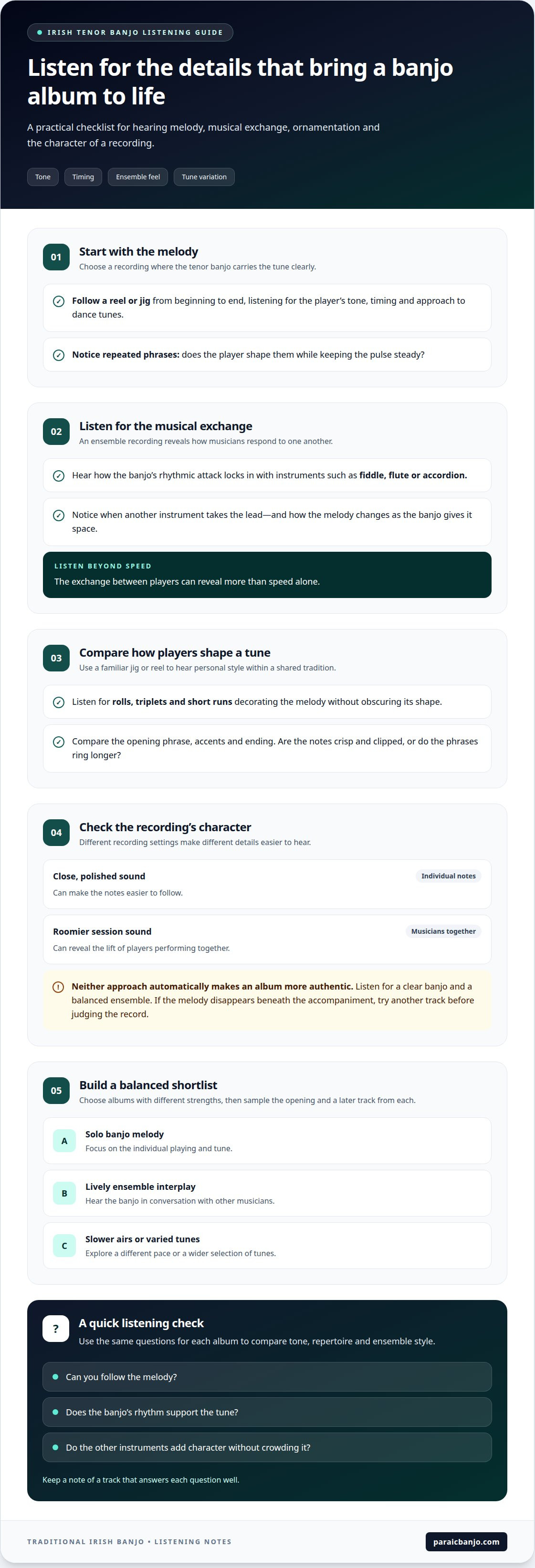
Start with recordings where the tenor banjo carries the melody rather than sitting quietly behind other instruments. This makes it easier to hear the player’s tone, timing, ornamentation, and approach to dance tunes. Choose a recording with clearly audible reels and jigs, then follow one tune through its full performance. Notice how the player shapes repeated phrases while keeping the pulse steady.
Next, seek out an album that captures ensemble playing, not just individual technique. Irish traditional music often depends on musicians responding to one another, and the banjo’s rhythmic attack can lock in with fiddle, flute, or accordion. Listen for how the melody changes when another instrument takes the lead. A useful example is a tune where the banjo begins prominently, then gives space to a fiddle or flute. That exchange reveals more than speed alone.
Compare arrangements by listening for ornamentation. Rolls, triplets, and short runs decorate a melody, but shouldn’t obscure its shape. Choose a familiar jig or reel and compare how two performances handle its opening phrase, accents, and ending. The differences may be subtle: one player uses crisp, clipped notes, while another lets phrases ring longer. This is a simple way to hear personal style within a shared tradition.
Recording context matters, too. A close, polished sound can make individual notes easy to follow, while a roomier session recording may reveal the lift of musicians playing together. Neither approach automatically makes an album more authentic. Listen for whether the banjo remains clear and the ensemble feels balanced. If the melody disappears beneath the accompaniment, try another track before judging the whole record.
Build a useful shortlist by choosing albums with different strengths: one that emphasizes solo banjo melody, one with lively ensemble interplay, and one with slower airs or a varied selection of tunes. Listen to the opening track and a later track from each. This gives you a quick sense of pacing and musical range, rather than relying on a single tune or first impression.
For a focused listening session, ask the same questions about each album: Can you follow the melody? Does the banjo’s rhythm support the tune? Do the other instruments add character without crowding it? Note a track that answers each question well. This turns a broad search for essential tenor banjo listening into a practical way to explore tone, repertoire, and ensemble style.
4. Who are the most influential Irish traditional banjo players and their albums?
Barney McKenna is one of the defining names in Irish tenor banjo. As a founding member of The Dubliners, he brought the instrument into a celebrated group sound that reached far beyond a solo setting. The band’s self-titled album, The Dubliners, is a useful introduction to that ensemble context. McKenna’s playing helped establish the banjo as a strong melodic voice in Irish song and dance music.
Finnegan Wakes offers another way to hear The Dubliners’ blend of songs and traditional tunes. McKenna’s role matters because the banjo does more than decorate the arrangements: it contributes drive and melodic definition. The group format also shows how a tenor banjo can sit alongside vocals and other acoustic instruments without losing its identity. These recordings make McKenna an important reference for anyone tracing the instrument’s place in Irish music.
Gerry O’Connor represents another essential strand of the tradition. His solo album No Place Like Home puts his banjo playing at the centre, offering a different perspective from McKenna’s work with The Dubliners. The contrast is useful: one artist plays within a well-known ensemble, while the other makes a more individual musical statement. Together, their recordings show how the same instrument can serve group arrangements and a solo artist’s vision.
Kieran Hanrahan is another notable Irish traditional banjo player, recognised for his work in traditional music settings. His career illustrates the different roles banjo players take on, from leading a tune to supporting a larger ensemble. Pairing his recordings with those by McKenna and O’Connor helps build a broader picture of the tradition, rather than treating one player or style as the whole story.
For a compact starting collection, begin with The Dubliners, Finnegan Wakes, and No Place Like Home. The first two introduce McKenna within The Dubliners’ group sound; O’Connor’s album offers a solo-led contrast. Add Kieran Hanrahan’s recordings to widen the picture. Together, these releases offer distinct artists and recording contexts, a solid foundation for exploring Irish banjo across ensemble and solo albums.
The Dropkick Murphys played at PetCo Park in San Diego in October 2021. That is a live-performance detail, not an album title, so it should be kept apart from the recording choices discussed here. A concert reference can broaden a reader’s sense of where music is encountered, while album listening answers a different question: how a player’s sound is presented in a particular setting. For McKenna, O’Connor and Hanrahan, the useful comparison remains between group playing and a solo-led statement, rather than drawing conclusions from a venue appearance. Treating these kinds of information separately keeps the listening path clear: use the named albums to compare banjo roles, and regard the PetCo Park performance as an independent live-music point of reference. It does not change which records form the starting collection.
5. What are the best Irish banjo albums by solo artists?
For a solo-artist album, start with the artist’s name and how the release is presented. “Solo” usually identifies the featured artist, not a recording made without collaborators. Check the musician credits and album notes to see who joins the banjo player and whether the project follows a consistent musical direction. This distinction helps set expectations before you choose a recording.
Album notes can reveal what makes a solo release distinctive. Look for details about the artist’s musical background, tune choices, and the thinking behind the arrangements. The notes may explain why particular pieces sit together or how the musician approaches familiar material. Treat them as context, not a promise that every track will sound the same. They can enrich a second listen by connecting the performances to the artist’s intentions.
Track order also shapes a solo album’s character. An artist may open with a defining performance, place contrasting pieces together, or use the final track to leave a particular impression. Read the track list as a sequence, not as a collection of unrelated titles. If the release includes notes about the repertoire, consider how they change your understanding of the programme as a whole.
Collaborators matter on solo-led recordings, too. Supporting musicians can add texture, answer a melodic phrase, or create a fuller ensemble sound while the banjo player remains the central artist. Check whether the credits distinguish featured performers from guests, and note which musicians appear across the album. This gives you a clearer sense of whether the release feels like one artist’s statement or a set of collaborations.
For a thoughtful collection, include solo albums that represent different artistic approaches. One may foreground a player’s interpretation of established tunes; another may show a broader collaborative vision. Keep the album notes with your listening record, and jot down the artist, release title, collaborators, and repertoire context you want to remember. This creates a useful reference without reducing your choice to a checklist of technical traits.
There’s no universal standard for the “best” solo release. The right choice depends on whether you value a personal musical statement, informative context, or the interplay between a lead artist and collaborators. Start with the credits and accompanying notes, then choose the release whose overall presentation interests you. This helps you discover solo banjo albums as complete artistic projects, not just collections of tracks.
4. Which Irish traditional session albums feature prominent banjo playing
Session albums with prominent banjo are easiest to identify through their credits and liner notes. Look for tenor banjo among the listed instruments, then see whether the notes describe its role across the recording. A listing that names the player but gives no arrangement context may not show how central the instrument is. Detailed credits can reveal whether the banjo is a regular part of the ensemble.
Pay attention to how an album describes its musicians. A session recording may bring several musicians together, while a solo artist’s release can still include an ensemble. The distinction matters: a session album may feature a banjo player prominently without making that player the sole focus. Credits that identify each performer and instrument help you understand whose sound shapes the record.
Album descriptions use different terms for different roles. “Featuring” may signal a guest appearance, while a musician listed as part of the core lineup may appear throughout the project. These phrases aren’t always used consistently, so read the full credits rather than relying on a short catalogue description. Check whether the banjo player is credited on the album itself or only in promotional copy.
Recording context can shape the sound and feel of a session album. A release described as live captures musicians performing together in a shared setting; studio recordings may have a more controlled production. Neither label alone tells you how prominent the banjo is, but each helps set expectations for the ensemble sound. Use the recording notes to understand the setting before choosing a release.
To keep track of what you discover, note the album title, banjo player, credited collaborators, recording context, and useful liner-note details. This makes it easier to distinguish ensemble projects with recurring banjo contributions from albums where the instrument appears only as a guest. Over time, the credits can reveal connections among musicians and sessions, giving your collection a richer map of Irish traditional playing.
Look for session albums that credit the tenor banjo and describe its role across the recording. A player listed as part of the core lineup, rather than only as a guest, is a stronger sign that the banjo features prominently.
5. Where can I stream or buy traditional Irish banjo albums
Start with the listening format that suits you. Streaming works well for sampling artists, while buying an album gives you a copy to keep or revisit. Search by the banjo player’s name and album title, then open the track list. A search for an artist alone may return playlists or unrelated recordings, so use the exact album title when you know it.
On a streaming service, check whether a result is a full album, a single track, or a user-made playlist. Play a track where the tenor banjo is prominent, then sample another to hear whether that sound continues. Catalogues differ, and a recording available on one service may not appear on another. If you’re exploring several players, save each album or create a listening list to keep your discoveries together.
Digital purchases suit listeners who want to own a recording without storing a physical disc. Before completing a purchase, review the album title, artist credit, and track list. These details help distinguish a full release from a similarly named track or compilation. If one tune is what draws you in, an individual track can be a practical addition to your collection.
A physical CD makes sense if you enjoy owning a tangible album. Check the edition and packaging details shown with the release, then consider how you’ll play it. A CD suits a dedicated player or compatible computer drive; a digital copy is more convenient on a device without a disc drive. Match the format to your listening habits, not just the cover.
For either format, use a simple check before choosing: confirm the artist, read the track list, and sample a tune. A reel can reveal rhythmic drive, while a slower air shows another side of the performance. If you’re comparing releases, note which album has the sound and tune selection you want. That makes it easier to find the recording again later.
Traditional Irish banjo albums can appear across streaming catalogues, digital music stores, and artist-owned sales pages. Availability varies by recording and format, so search by both the artist and exact album title. For a direct way to explore Irish banjo music, browse Irish banjo recordings and choose the listening format that fits you.
Páraic Banjo: Not Before Time - 39 Years in the Making (Digital Album)
Not Before Time - 39 Years in the Making is Páraic Mac Donnchadha’s debut, recorded live with expert musicians. Its 18 tracks capture the feel of traditional Irish session music, making it a natural choice if you want banjo-led playing grounded in ensemble performance. Choose the digital album to listen to the full collection, or select individual digital tracks if you’re drawn to particular tunes. A physical CD is also available for listeners who prefer a tangible copy.
The title reflects a project shaped over 39 years, bringing long-held musical passion into one album. Explore Not Before Time - 39 Years in the Making for a session-focused listen. If you’d like to know more, contact Páraic Banjo.
Keep Following the Tune
Let traditional Irish banjo albums lead you beyond a single listen. Choose a tune that stays with you, then notice how its melody, rhythm, or arrangement shapes your next choice. You might follow the sound of a particular phrase, seek out a vocal interpretation, or explore a fresh arrangement of a traditional song. A little curiosity can open a new path through the music.
There’s no need to build a collection all at once. Let your ear guide you, keep track of performances you want to revisit, and make room for new discoveries. The pleasure lies in hearing familiar music anew and finding the players whose touch speaks to you.
If you’d like to continue exploring Irish banjo music, contact Páraic Banjo about banjo. Keep listening, stay curious, and enjoy the journey.
Frequently Asked Questions
What are the best traditional Irish banjo albums?
A strong starting point is Páraic Mac Donnchadha’s Not Before Time, especially if you enjoy Irish session music led by tenor banjo. The best choice depends on what you want to hear: solo playing, lively ensemble interplay, or a particular mix of tunes. Sample a few tracks and notice which player’s tone and phrasing make you want to listen again.
Which traditional Irish banjo albums are available on vinyl or CD?
Not Before Time - 39 Years in the Making is available as a physical CD from Páraic Banjo. The album includes a booklet with liner notes, which adds musical context as you listen. Vinyl formats vary by release, so focus on the format named for the specific album you’re considering. If you prefer a tangible copy, the CD edition is a clear option.
Comments