Traditional Irish Slip Jigs on Banjo: Tunes, Rhythm, and Roots

Updated: 1d
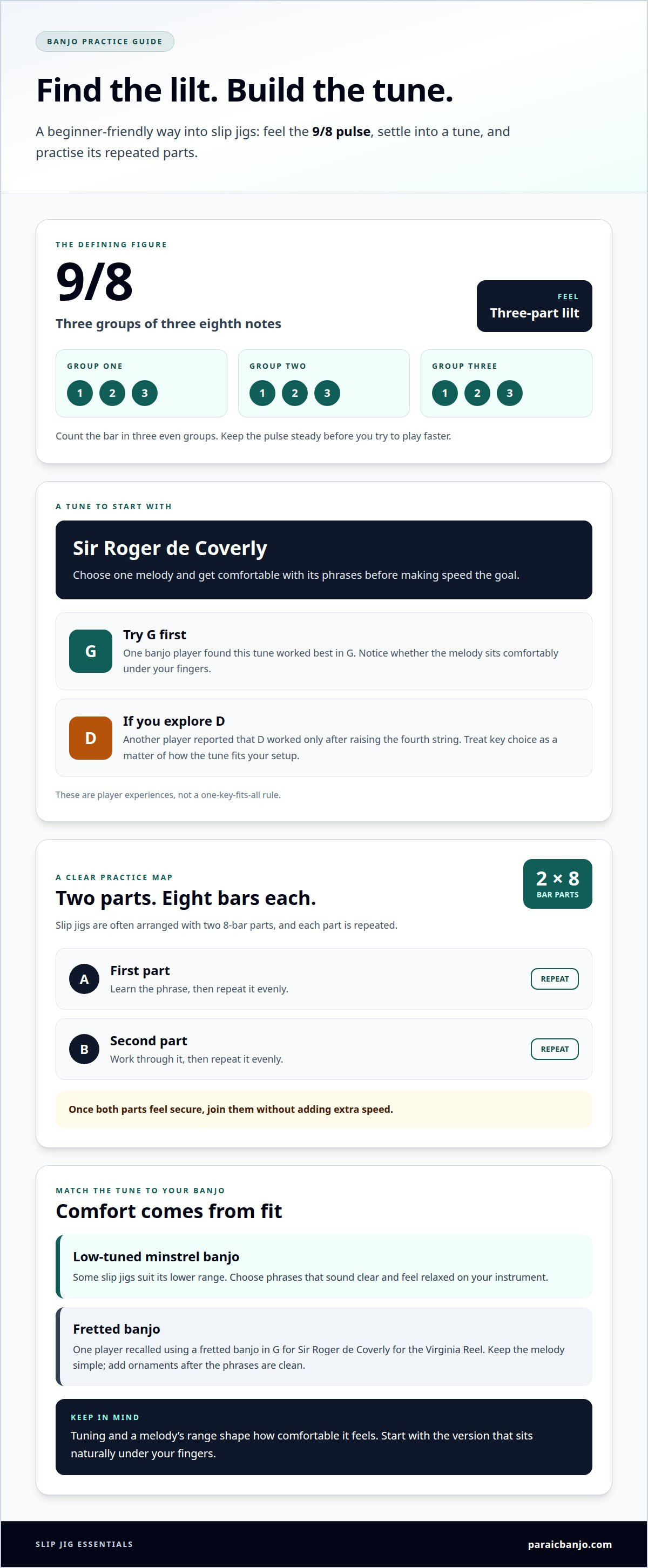
The slip jig’s lilt comes from an unmistakable nine-beat bar. It’s an Irish dance tune in 9/8 time, counted as three groups of three eighth notes, and traditional Irish slip jigs on banjo bring that rolling pulse to life through melody and picking. Once you feel the three-part swing, the rhythm becomes much easier to follow.
If 9/8 seems tricky at first, you’re not alone: its motion can feel different from the more familiar pulse of a reel. This guide shows you how to count a slip jig, shape the rhythm on banjo, and choose tunes that make a rewarding starting point. You’ll also get a glimpse of how the form took root in the wider Irish and banjo traditions. Take it one bar at a time, and let the lilt settle in.
Table of Contents
Beginner slip-jig recommendations
A beginner-friendly slip jig is one whose melody feels comfortable on your banjo as you learn its rolling rhythm. Start with Sir Roger de Coverly, and try its phrases under your fingers before settling on a key. This gives you a specific melody to practise without making speed the first goal.
Sir Roger de Coverly is a slip jig that one banjo player found worked best in G. Another player reported that D worked only after raising the fourth string. These experiences show why key matters: the same melody can feel natural in one setup and awkward in another. Try G first and notice whether the melody sits within easy reach on your strings. If you explore D, pay attention to the fourth string rather than forcing notes that feel uncomfortable.
The minstrel banjo is an earlier type often associated with low tuning. Some slip jigs suit its lower range, making it a useful starting point if you play one. Choose a melody that sounds clear in your instrument’s register, then keep its phrases relaxed. Not every tune will fit every banjo in the same way: tuning and the melody’s range both shape the result.
A repeated part is a section of a tune played again before moving on. Slip jigs are often arranged with two 8-bar parts, and each part is repeated. Use that structure as a practice map: learn the first part, repeat it evenly, then work on the second. Once both parts feel secure, join them without adding extra speed. The repeated passages give your ear a chance to recognize the melody and your hands time to settle into its movement.
A fretted banjo has frets marking the notes along its fingerboard. One player recalled using a fretted banjo in G to play Sir Roger de Coverly for the Virginia Reel. That offers a practical way into the tune, especially if G feels comfortable on your instrument. Keep the melody simple at first, and add ornaments only after you can play each phrase cleanly.
Pick one tune, such as Sir Roger de Coverly, rather than switching between melodies.
Try G as a starting key, then compare how the tune feels in another key.
Practise each 8-bar part separately, repeating it before joining the sections.
On a low-tuned minstrel banjo, choose phrases that sit comfortably in the instrument’s range.
When choosing traditional Irish slip jigs on banjo, let comfort guide your first choice. Begin with the melody, keep each repeated part steady, and build from there.
Historical origins and classification
A slip jig is an Irish dance tune in 9/8, with a lilting pulse distinct from the familiar 6/8 jig. Its history also crosses into banjo collections, where tune books preserved melodies and labels for later players. Looking at those printed records helps explain how musicians classified the form, and why older books may use different names.
Howe’s 1,000 Jigs and Reels is a tune collection that included slip jigs in 1867. Its title places the form among the jigs and reels gathered for musicians, rather than treating it as an isolated curiosity. Ryan’s Mammoth Collection also included slip jigs in 1883. Together, these named collections show the repertoire appearing in American printed music during the nineteenth century. They offer useful historical landmarks, though a collection date doesn’t tell us when a tune first entered oral tradition.
A 6/8 jig is a jig counted in two groups of three eighth notes, rather than the slip jig’s three groups of three. Early banjo books included 6/8 tunes such as Rory O’More, Lannigan’s Ball, and Irish Washerwoman. Four commonly referenced banjo tutorials appeared during 1855-1865, while slip jigs appeared in American tune books published 20 years later. That sequence gives players a practical distinction: an early banjo book may contain Irish jigs without including slip jigs. Check the time signature before treating every jig title as the same rhythmic form.
A three-part slip jig has three distinct sections instead of the more familiar two-part layout. Sir Roger de Coverly is described as a three-part slip jig, making it a useful example of variation within the category. In 1907, O’Neill grouped hop jigs and slip jigs under the label “Hop or Slip Jigs.” That shared heading shows how classification could bring related tune types together. When reading an older collection, note the printed label, then listen for the tune’s meter and phrasing.
A tune classification is a label that groups music by features such as rhythm or dance type. O’Neill’s 1907 heading is one clear example, while the 6/8 melodies in early banjo books illustrate a separate category. Players have also described slip jigs as having declined over the last century. Treat that as a comment on changing repertoire, not proof that the tunes disappeared. Collections by Howe, Ryan, and O’Neill still give curious banjo players names and dates to explore.
Try this quick reading method with a printed tune: find its title, inspect the time signature, and identify its section structure. Compare a 6/8 example such as Rory O’More with a slip jig before you practise. That simple comparison connects the historical labels to what your hands and ears encounter. For a listening companion rooted in the tradition, explore traditional Irish banjo playing.
Slip-jig repertoire and tune examples
A useful slip-jig repertoire balances melodies you enjoy with pieces that suit your playing. Build yours by comparing phrases, range and character, rather than simply collecting titles.
Slip-Jig Repertoire
A slip-jig repertoire is your personal selection of melodies played in the slip-jig style. To shape one, choose pieces with contrasting melodic movement. A tune with a rising opening phrase, for example, can sit beside one that starts lower and turns upward later. These are listening cues, not fixed rules, but they help you hear how melodies differ.
Use a notebook to track the tunes you encounter. For each one, record its title, where you heard it and a short description of its opening. Note any passage that stands out, such as a repeated note, a leap between pitches or a longer held tone. These details make melodies easier to remember than titles alone.
When two versions of a tune sound different, compare them phrase by phrase. Mark where one adds a turn or changes a note, then decide which version feels clearest under your fingers. Keep both in your notes if each has a distinctive character. This simple comparison can make your repertoire more personal and help you recognise how musicians shape a tune.
Slip-Jig Tune Examples
A slip-jig tune example can show how a melody moves through a phrase. Imagine a simple passage that begins with three repeated notes, rises, then settles downward. Compare it with another short passage that starts with a leap and answers with a descending line. These practice examples help you listen for melodic shape without relying on a particular tune name.
To compare the examples, sing each imagined passage before playing it. Hum the repeated-note idea first and notice whether the rising motion feels smooth. Then hum the leap-and-answer phrase, keeping its direction clear. Play both on banjo at a comfortable pace. Focus on how your fingers move between notes, and note which phrase feels easier to play cleanly.
Use these examples to evaluate unfamiliar melodies, not as a substitute for learning tunes from the tradition. When you find a recording or written melody, identify its opening shape and one phrase that returns or changes. Write those details beside the title. Over time, this listening habit helps you choose pieces with varied character and remember what makes each melody distinct.
Slip-jig rhythm and picking on banjo
Picking articulation is how you shape each note with your picking hand. For a slip jig, aim for clean attacks and an even tone, then vary the strength of your strokes to bring out the melody’s natural shape. Avoid giving every note equal force. Try playing a short phrase twice: first with an even touch, then with slightly more emphasis on its melodic peaks.
Tenor banjo and five-string banjo have different string layouts, which affect fingering choices and the sound around the melody. Tenor playing generally focuses on the melody across its strings, while the five-string instrument can add its short drone string. Let the arrangement suit the instrument. Don’t force a drone into a phrase if it clouds the tune.
A practical setup keeps notes clear and lets you move comfortably across the fingerboard. Choose strings and tuning to suit your banjo and the melody’s range, rather than relying on one setup for every tune. If notes sound muddy or feel hard to reach, try the phrase in another comfortable position before changing your picking motion. Keep the melody easy to hear.
String crossing is the picking hand’s movement from one string to another. Practise a phrase that moves between adjacent strings, keeping your hand close to the banjo head and avoiding a large, tense swing. Then try a phrase with a wider string change. Notice where your hand hesitates and make the movement smaller. Smooth crossings help connect the melody, especially when notes move quickly between strings.
Left-hand preparation means placing a fretting finger near its next note before it is needed. Choose a short phrase, identify the largest finger movement and practise that shift slowly without ornaments. Once it feels easy, connect the phrase to the next one. This targets the movement causing difficulty instead of slowing every note equally.
Listen to a traditional Irish banjo recording and follow one melodic line from beginning to end. Notice how the player gives important notes room without crowding the phrase. Then record yourself playing and listen for clipped notes, noisy string changes or a picking hand that lifts too far. Small adjustments can make the tune sound clearer and more relaxed.
Slip-jig time signature and counting
A time signature shows how musical beats are grouped inside each bar. A slip jig uses 9/8, meaning each bar contains nine eighth-note pulses. Feel those pulses as three groups of three: “ONE-two-three, TWO-two-three, THREE-two-three.” Keep the groups connected, but give each group a gentle lift rather than stressing all nine notes equally.
An eighth-note pulse is one of the nine counted subdivisions in a 9/8 bar. Start by tapping those notes evenly while saying the count aloud. Then mark the first pulse of each group with a slightly firmer tap. The result should feel like three lilting steps, not nine separate accents. Try the pattern slowly before bringing a melody into it.
A bar is one complete unit of music, and counting bars helps you follow a dance tune’s length. Competition dancers perform 40 bars of a slip jig where they would dance 48 bars of a reel. That comparison makes the meter practical: a slip jig’s nine-part grouping gives dancers a distinct phrase length and pulse from a reel. Keep the count steady rather than adding beats to make the tune feel longer.
A counting pattern is a spoken or tapped guide to help you keep the meter. Use this simple sequence with a slip-jig phrase:
Tap nine even pulses, grouped as three sets of three.
Say “ONE-two-three” for the first group, then repeat for groups two and three.
Play one short phrase while keeping the same spoken count.
Continue into the next bar without pausing between groups.
For a tune such as Sir Roger de Coverly, count across the melody rather than restarting at every note. If a phrase crosses a bar line, keep the pulse moving. A metronome can mark the main groups while your voice fills in the three subdivisions within each group. This helps you spot where a phrase begins and where the next bar turns.
A dotted-quarter beat groups three eighth notes into one larger pulse. Use that idea if counting all nine subdivisions feels busy: tap three steady main beats, then fit three lighter notes inside each beat. Return to the full “one-two-three” count whenever the melody becomes less clear. On banjo, keep the picking hand relaxed and let the count lead; rushing the subdivisions can blur the tune’s lilting shape.
Try counting one bar aloud, then play that bar twice without changing your pulse. Next, join it to the following bar and keep the accents in groups of three. Explore traditional Irish banjo recordings to hear how a steady pulse supports the melody.
Páraic Banjo: Not Before Time - 39 Years in the Making (Physical CD)
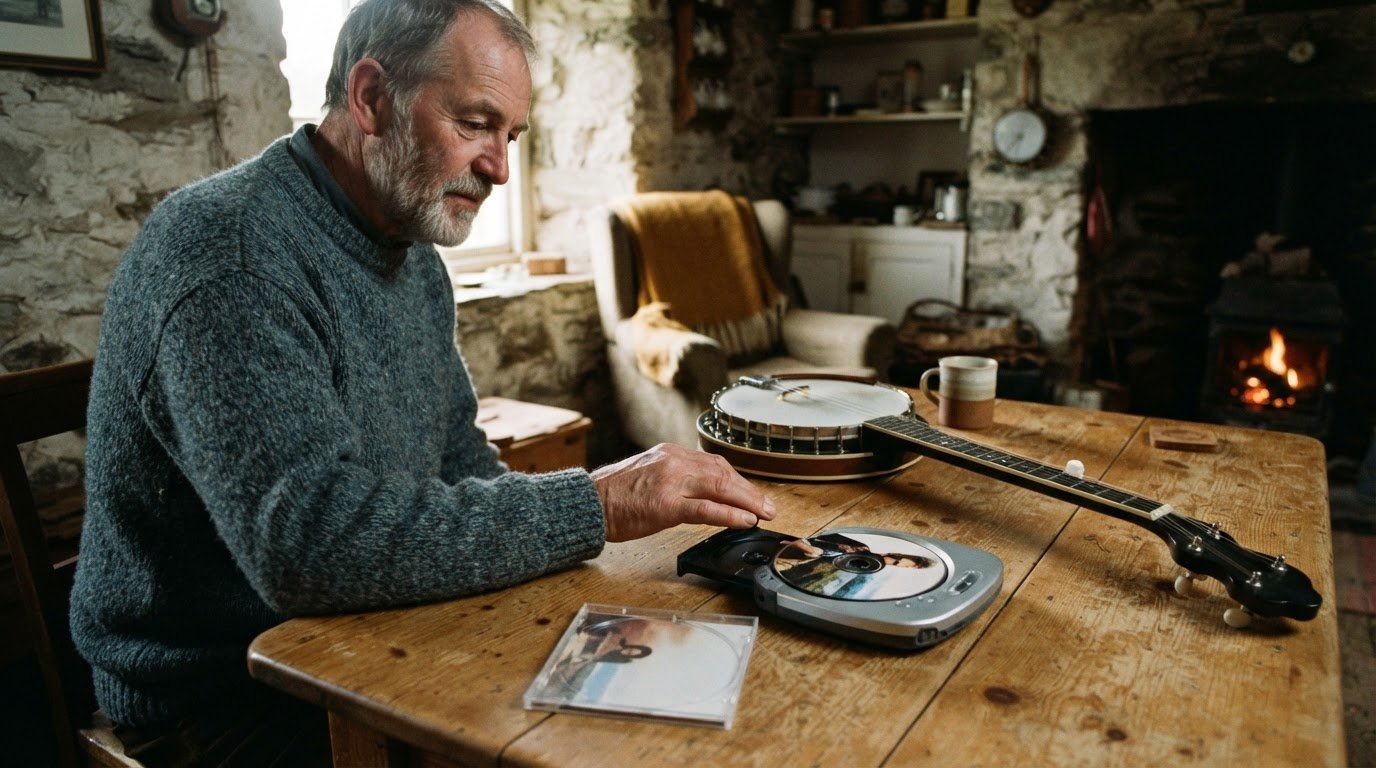
Páraic Banjo’s Not Before Time - 39 Years in the Making offers a listening companion for exploring the sound and feel of traditional Irish session music. The album brings together 18 tracks recorded live with expert musicians, so you can hear the banjo within a shared ensemble rather than in isolation.
Choose the physical CD if you prefer a tangible album, the digital album for a complete digital listen, or individual digital tracks to focus on selected pieces. As you listen, notice how the banjo’s rhythm supports the melody and interacts with the other musicians. Paying close attention can deepen your appreciation of traditional playing beyond counting or practising a tune.
Explore the album and choose the format that suits your listening: visit Páraic Banjo.
Let the next tune lead you on
Make your next step musical: choose a tune, listen closely, then bring its phrasing back to your banjo. As you explore traditional Irish slip jigs on the banjo, give the melody room to breathe. A steady pulse matters, but so does the lift between phrases. Each time you play it, you may notice a detail your fingers missed before.
For a listening companion, Páraic Banjo offers Not Before Time - 39 Years in the Making as a Physical CD or Digital Album, plus Individual Digital Tracks. Pick the format that fits how you like to listen, then settle in with the music.
Explore Páraic Banjo’s album and tracks, and keep the music moving. Go on, give that next tune a turn.
Frequently Asked Questions
What is a slip jig?
A slip jig is an Irish dance tune with a characteristic 9/8 meter and a flowing, triple-beat feel. The notation’s top number indicates nine subdivisions in each bar, while the bottom number identifies the eighth note as the unit. That written signature helps distinguish the form on a page. For listening, focus on how the melody moves across the bar rather than judging by the tune’s title.
What defines a traditional Irish slip jig, and how does its 9/8 rhythm work?
A traditional Irish slip jig combines 9/8 meter with melodic phrasing shaped for the dance style. Read the notation by tracking each bar’s nine eighth-note units, then notice where the melody gives weight to its larger beats. To study a written tune, mark the bar lines and sing each phrase before playing. This connects the notation to the melody without treating every written note as equally strong.
Which traditional Irish slip jigs are commonly played on banjo?
Look for tunes identified specifically as slip jigs in Irish tune collections or recordings, rather than choosing every piece labelled “jig.” The classification matters because 6/8 jigs belong to a different rhythmic form. Before learning a melody, check its time signature or listen for its phrasing, then note the source and title in your repertoire list. This helps you build a reliable set without mixing tune types.
How do you adapt Irish slip jig tunes for the five-string banjo?
Adapt a tune by fitting its melody to comfortable positions on the five-string banjo’s fingerboard. Start with the written or remembered melody, find each phrase on the neck, and choose fingerings that avoid unnecessary jumps. If a passage feels cramped, try another position while preserving the tune’s shape. Play both versions slowly, then keep the fingering that makes the phrase easiest to repeat cleanly.
What picking techniques and ornamentation are used for Irish slip jigs on banjo?
Banjo players use ornaments such as cuts and rolls to decorate melody notes without losing the tune’s shape. A cut briefly interrupts a note with a higher grace note; a roll adds a compact flourish around a sustained pitch. Learn an ornament separately before adding it to one suitable phrase. Keep the melody recognisable, and leave the ornament out if it makes the passage sound crowded.
What tempo and rhythm should you use when playing a slip jig on banjo?
Choose a practice tempo slow enough for clean notes and relaxed movement, then increase it gradually as the passage settles. A metronome can help you keep an even pace, but listen for phrasing too: a mechanically steady tune can still sound stiff. Record a short section at each pace and compare the melody’s clarity. Keep the faster setting only if the notes remain distinct.
Where can I find traditional Irish slip jig banjo tabs, notation, or recordings?
Traditional tune collections are useful for notation, while recordings let you hear phrasing and ornament choices. Páraic Banjo’s official site is a place to explore Irish banjo recordings. When using written music, compare the time signature and bar lines with what you hear, since notation and performance can emphasize a tune differently. Keep the source beside your own notes so you can return to the same version during practice.
What beginner exercises help with playing slip jigs on banjo?
Learn a melody in short sections: sing one phrase, pick it from memory, then check it against your notation or recording. Join two phrases and listen for a smooth transition. Finish by playing the whole tune without stopping, even if you simplify tricky ornaments. This sequence builds recall and continuity, helping you move from isolated passages toward a complete, flowing performance.

Comments